


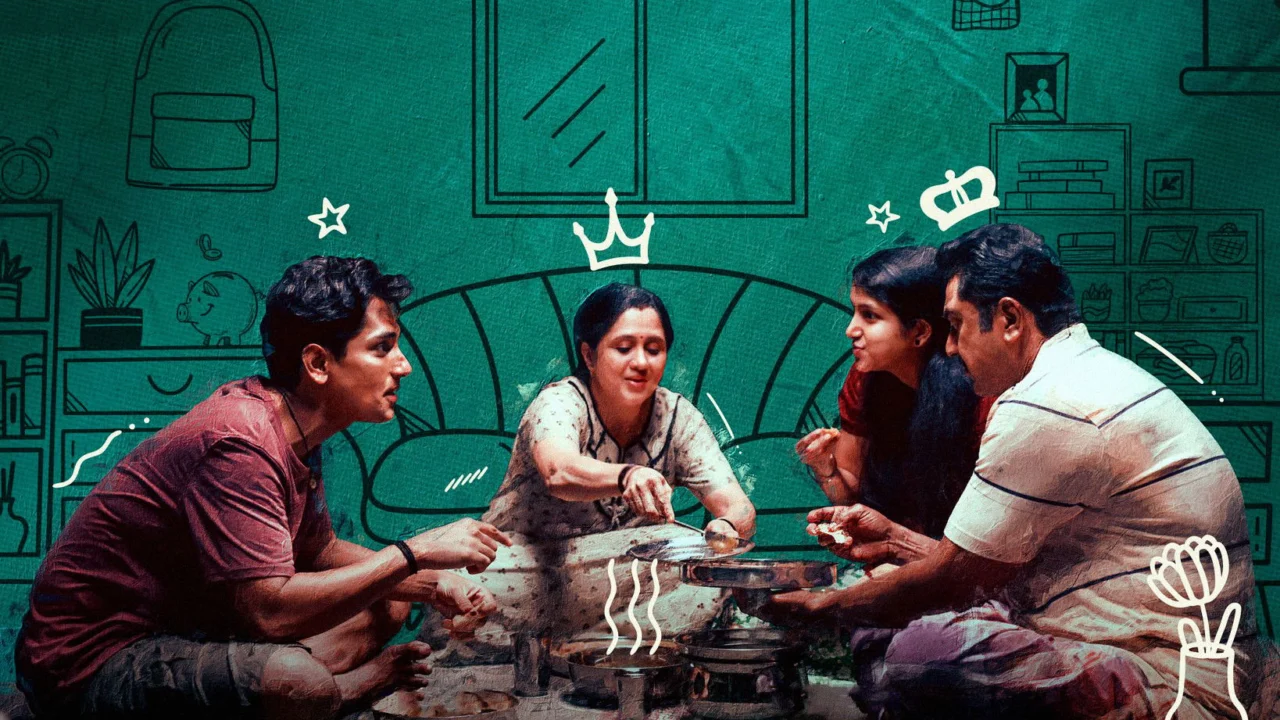
3BHK (2025) Movie ft. Devayani, R., and Siddharth
3BHK (2025) is a Tamil family drama that treats a three‑bedroom apartment not as property, but as the axis around which an entire middle‑class life keeps spinning. Sri Ganesh doesn’t chase high concept here; he builds a simple, stubborn idea , “one day we’ll have our own flat” , and shows how that promise shapes a family for decades.
Devayani and R. Sarathkumar play Shanthi and Vasudevan, a couple who land in Chennai with two kids and a suitcase of modest dreams. Siddharth’s Prabhu grows up watching their entire existence , jobs, sacrifices, arguments, celebrations , get measured against one benchmark: are they any closer to that elusive 3BHK?

Story, timeline and emotional core
3BHK tracks the family across three distinct phases: cramped rented houses in the 2000s, slightly better rentals as incomes rise, and finally the long, grinding march towards a down payment. Every major life event , a promotion, a medical emergency, a wedding proposal , is filtered through the question of EMI versus dignity.
Prabhu’s journey is the film’s spine. As a teenager, he resents the constant “adjust, adjust” mantra and the humiliation of landlords dictating rules. As an adult, he becomes the extra engine in the household, taking up whatever work he can to move the goalpost a little closer, even as he quietly wonders if the dream is worth the toll.
The emotional core lies in how the house, which is supposed to unite them, often turns into the third person in every relationship: the reason Vasudevan skips a trip, the excuse Shanthi uses to deny herself small joys, the lens through which Prabhu views every success and failure.

Performances and characters
Devayani’s Shanthi is all about accumulated fatigue. She isn’t written as a loud martyr; she’s the kind of mother who quietly downgrades her own needs first , sarees later, jewellery later, check‑ups later , while insisting she’s “fine.” Her performance is full of small, lived‑in gestures: counting coins twice, hiding worry behind a joke, checking ceiling damp patches every monsoon.
R. Sarathkumar’s Vasudevan is a gentle, principled government employee who believes in playing by the book even as the city around him rewards shortcuts. His moments of anger are rare, which makes them sting when they arrive , especially when he realises that his honesty may have cost the family years of progress.
Siddharth’s Prabhu gets the most visible arc, from sulky schoolboy to hardened loan calculator. He carries the frustration of a generation stuck between parents’ sacrifice and a housing market that keeps moving out of reach. The performance shines when he’s quietly negotiating for better pay, lying to protect his parents from bad news, or snapping under the weight of everyone’s expectations.

Direction, writing and texture
Sri Ganesh shoots homes like emotional maps. Ceiling fans with wobble, plastic chairs, water cans in corners, balconies stacked with clothes , every space tells you exactly where the family is on its financial curve. As the film moves forward, the tiles improve, windows get bigger, but the conversations rarely get more relaxed.
The writing is episodic by design. Instead of a single “big twist,” you get a series of life chapters: school admissions, job interviews, hospital bills, housing society meetings. Almost every chapter ends with some version of “we’ll manage,” yet you feel the cost piling up each time.
Crucially, the film avoids moral lecturing. It doesn’t blame the dream of owning a flat, but it also refuses to romanticise the grind. You see how social pressure, WhatsApp flexing and relatives’ comments weaponise that dream until it becomes almost a burden of proof: if you don’t buy, did you even try?
What works strongly
- The family dynamic feels real. Fights are over small things – fan left on, gas cylinder empty, neighbour’s taunt – and the big stuff erupts only after enough small cuts.
- There is no “hero shot.” 3BHK is an ensemble where parents and children all get their own moments of strength and weakness.
- The film captures the specific anxiety of Indian middle‑class housing: rising rents, shady builders, endless documentation, fear of fraud, and the sinking feeling when prices jump just as you’re ready.
- Humour is woven in naturally through relatives, colleagues and a couple of sharply observed society meetings, giving breathers without undercutting the larger tension.
Where it wobbles
The commitment to covering many years means some transitions feel abrupt. A few secondary characters who seem important in one phase (friends, neighbours, bosses) vanish in the next with little closure, which can be jarring.
The screenplay occasionally underlines its points more than necessary. Lines about “log kya kahenge” or “ghar ke bina izzat kahan” are powerful the first few times; later, you wish they were left implied rather than said outright.
Also, the third act flirts with melodrama. A key health scare and a dramatic confrontation around a builder’s office push the emotional volume higher than the rest of the film, which had mostly stayed grounded.
Audience connect and impact
If you come from a renting, saving, EMI‑calculating household, 3BHK is likely to hit uncomfortably close. The film taps into a shared memory bank: sleeping in the hall so guests can use the bedroom, putting off vacations indefinitely, parents reading property ads like wish lists.
For younger viewers, it’s a reminder of how much of their parents’ identity was tied to a physical address. For older audiences, it plays like a mirror of decades spent chasing a front‑door nameplate.
Importantly, the final stretch doesn’t pretend a house magically solves everything. It treats that 3BHK more as a symbol of survival than as a happily‑ever‑after.
Overall verdict
3BHK (2025) is a quietly powerful middle‑class saga that turns a very ordinary dream into a lens for looking at ambition, compromise and love inside a family. It’s not flashy, and it occasionally repeats itself, but that repetition is part of the point , the grind looks the same, year after year.
For anyone who has grown up hearing “jab apna ghar hoga…” at the dining table, this film will feel less like fiction and more like a conversation you’ve already lived through.
Rating: 4.0/5