
Don’t Trouble the Trouble (2026): Fahadh Faasil Charms Through A Fantasy Comedy That Loses Its Own Spell


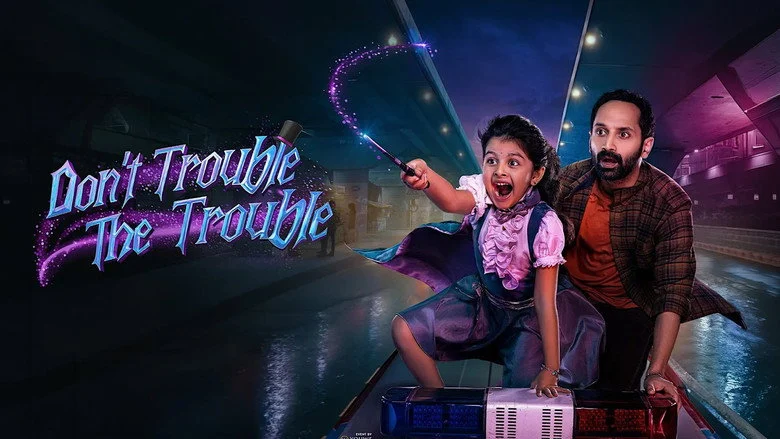
Fahadh Faasil spends the first act of Don’t Trouble The Trouble doing what he does better than almost anyone working in Indian cinema: playing a man who is lying, and enjoying it. Suri, a two-bit crook moonlighting as a stage magician, palms a coin, sells a fake miracle, and grins at the mark with the serenity of a man who has never once been punished for his sins. It is a magnificent piece of sustained duplicity, loose-limbed, quick-eyed, unbothered. And then Shashank Yeleti’s screenplay hands him a child who believes the lie is real, and the film arrives at the only question it genuinely wants to ask: what happens when a con artist’s fiction is taken literally by someone with the power to enforce it?
The Trick That Starts It All
Yeleti builds his opening around a single causal domino: Suri dupes moneylender Aslam Bhai (Mahesh Manjrekar), the debt pressure tightens, and a trick gone wrong deposits Divya (Ssara Palekar) into his orbit. Watch how the film stages that first collapse. Manjrekar plays Aslam Bhai not as a theatrical heavy but as a businessman with a ledger and a short fuse, his menace is administrative, which is exactly right for a story about a man drowning in obligations rather than enemies. The scene works because the threat is mundane and the consequence is not. Suri’s deception doesn’t summon a monster; it summons a runaway child with supernatural abilities who mistakes him for a genuine magician. It’s a clean, elegant genre ignition, mistaken identity as metaphysics, wish-fulfilment as trap.
The problem is that Yeleti spends the rest of the film paying off that elegance with diminishing returns. The middle stretch, in which Divya’s presence detonates chaos across the locality and drags Suri deeper into a mess he cannot con his way out of, is where the screenplay’s grip visibly slackens. The film keeps escalating the supernatural stakes without deepening the rules governing them. Divya’s powers remain a device rather than a system, they arrive when the plot needs a shove and recede when it needs a breather. For a fantasy to generate real tension, the audience must understand the cost of magic. Here, the cost is never itemised, so the chaos reads as noise rather than consequence.
What Fahadh Faasil Is Actually Doing
Which is why the film survives at all, and it survives entirely on its lead. Faasil’s Suri is not a redemption arc performed in broad strokes; it’s a series of tiny recalibrations. Early on, he looks at Divya the way a man looks at an asset, a quick appraisal, a mental calculation, a decision to exploit. Later, in the paired travel passages where the film shifts between fantasy and sentiment, the same eyes do something else: they check on her before checking on himself. That inversion, delivered without a single speech about learning to care, is the film’s most accomplished piece of craft. It’s a performance built on the granular mechanics of self-interest slowly losing its footing.
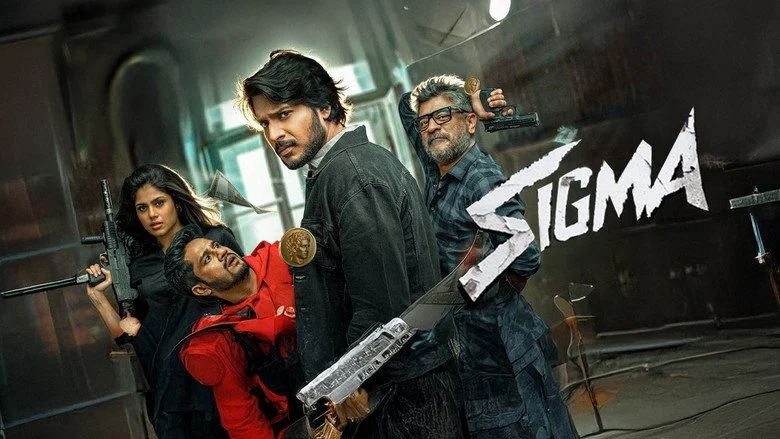
Ssara Palekar’s Divya is the necessary counterweight, and she holds it. Her conviction, that Suri is the magician she’s been looking for, is played straight, with no winking, and that sincerity is what makes the comedy land. The pair’s chemistry is the film’s genuine engine, and the scenes where Faasil simply reacts to her belief in him are the ones audiences will remember. It’s worth noting that the film’s emotional architecture rests on a child performer carrying the fantasy logic while the adult carries the moral weight, and Yeleti balances that division more confidently than he balances his own plot. For a contrasting approach to a similarly premise-driven genre exercise, our review desk’s take on Sigma review examines how a high-concept hook can sustain a thriller, or fail to.
The Second Half Stops Casting Spells
Then comes the stretch that sinks it. Roughly from the midpoint onward, the film becomes repetitive: Suri and Divya move, trouble follows, Suri improvises, trouble follows again. The editing, which paces the first half around Suri’s escalating debt and Divya’s introduction with reasonable rhythm, simply slows. Scenes that should escalate instead recycle. And the fantasy premise, a magician-versus-real-magic contrast that should be the film’s thematic spine, gets progressively underused, reduced to background texture while the narrative treads water.
This is where Yeleti’s direction betrays its own instincts. He has a clear setup, a strong comic-fantasy conceit, and a lead who can hold tone through tonal whiplash. What he doesn’t have is a second act that knows what to do with them. The screenplay is linear and cause-and-effect by design, which is fine, but linearity requires acceleration, and this one decelerates. Kaala Bhairava’s score and Brad Francis’s cinematography are credited and functional, but available material offers no evidence that either is being used to compensate for the structural sag. The film’s production scale, backed by Arka Mediaworks, is visible on screen; the storytelling discipline is not always.
It’s a familiar shape for a certain kind of Indian fantasy-comedy: a brilliant premise, a magnetic star, and a back half that mistakes movement for momentum. For another look at how a premise-driven film handles its own mechanics, our review of Maaruvesham verdict traces a similar tension between clever construction and execution.
Verdict: A Star Vehicle With A Stalled Engine
Don’t Trouble The Trouble is a 2-hour-38-minute film that feels longer than it is, and that is the most damning thing you can say about a comedy with this much charm at its centre. Fahadh Faasil delivers exactly what the film needs, a morally compromised man whose slow pivot toward responsibility never announces itself, and Ssara Palekar matches him with a performance of unforced sincerity. The premise is accessible, the emotional hook is real, and the magician-versus-magic conceit is genuinely good. But the screenplay loses the thread, the fantasy goes unexploited, and the pacing collapses after the interval.
See it if you’re a Faasil completist or you have patience for a film that front-loads its best ideas. Skip it if you need a second half as sharp as the first. ★★★☆☆ (3/5), a winning performance trapped in a screenplay that ran out of tricks. For more of our cinema coverage, browse Telugu Fantasy reviews.