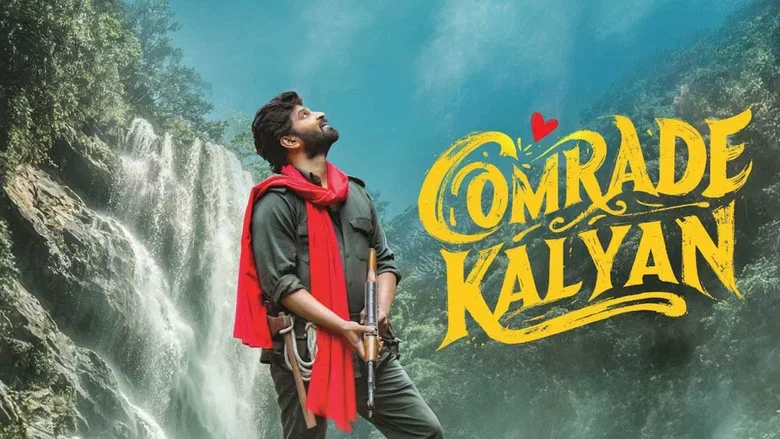
Comrade Kalyan (2026): Sree Vishnu Anchors A Tonally Split Period Comedy That Mistakes Chaos For Character


The old Alankar touring-talkies has a screen held together by stitching, a projector that whines like a dying generator, and an audience that pays in coins to watch R. Narayana Murthy films because the village still believes in the revolution. This is where Janakiram Marella plants his flag in Comrade Kalyan, and for roughly forty minutes, the film justifies its own existence. Kalyan, played by Sree Vishnu, runs this decaying monument to communist cinema not out of conviction but out of arithmetic. He needs bodies in seats. If those bodies happen to be red sympathisers, so be it.
It is a genuinely sharp premise: a small-time operator exploiting ideological nostalgia for ticket sales, only to be swallowed by the very politics he is peddling. The early-1990s Andhra–Odisha border setting gives the film a specific, humid texture that most Telugu comedies of this scale never bother to build. The dialect shifts, the debt economy, the way local disputes escalate into police cases over nothing, Marella gets this world right. It is the story he chooses to tell inside it that starts to wobble.
When A Debt Payment Becomes A Revolutionary Identity, The Screenplay Starts Cheating
The engine of the plot is Mahima Nambiar’s Sitara, an Odia woman whose brother has borrowed money from a lender who now wants her hand in marriage as repayment. It is a coercive arrangement rooted in real rural economics, and Nambiar plays the quiet humiliation of it with a stillness that keeps the film grounded whenever the comedy threatens to float away. Kalyan decides to pay the debt himself. Romantic, foolish, and entirely consistent with a man who believes every problem has a transactional solution.
What follows is where Comrade Kalyan begins to lose its grip. Through a chain of misunderstandings that the screenplay never fully earns, Kalyan is mistaken for a Naxal operative. The film wants us to accept this as organic escalation. It is not. The transition from debt-settling theatre owner to wanted insurgent happens so quickly, and with so little connective tissue, that the audience is forced to do the screenplay’s work. Just as a contemporary theatrical release like Toxic attempted to build a world of consequence around a single premise, Comrade Kalyan leans on momentum where it needed architecture.
The IPS officer played by Shine Tom Chacko is the film’s most reliable source of dread. He does not shout. He does not threaten. He simply occupies rooms with the flat, unblinking patience of a man who has done this before and will do it again. His presence compresses the narrative space around Kalyan in a way the screenplay’s coincidences cannot. Chacko understands that institutional menace is a function of stillness, and his performance is the closest the film comes to genuine thriller discipline.
The Comedy Works When It Stays In The Theatre, Dies When It Enters The Jungle
Marella’s strongest instinct is to keep the humour rooted in occupational behaviour. Kalyan haggling with distributors, Kalyan bribing a projectionist, Kalyan convincing villagers that a particular film is “politically necessary” when it is simply the cheapest print he could acquire, these scenes hum with the specificity of a man who treats ideology as inventory. Raadhika Sarathkumar, as Kalyan’s mother, adds a layer of domestic chaos with her petty legal disputes, though the film never quite decides whether she is a comic device or an emotional anchor.
The problem is tonal. Once the kidnapping plot activates and the police pursuit intensifies, the film keeps reaching for the same comic register that worked in the theatre. Jokes land in the middle of sequences that require tension. The farce does not disarm the danger; it dilutes it. The film’s treatment of Naxalism is not political, it is scenic. The insurgency exists as a backdrop for mistaken identity, not as a lived reality with stakes. The screenplay resists the kinetic sensationalism that overtook genre peers, opting instead for a deliberate, suffocating dread in its best moments, but it cannot sustain that discipline.
Vijay Bulganin’s score tries to bridge the gap, pushing comedic rhythms during the first act and shifting to percussive urgency in the second. But the music cannot solve what the script has not decided. By the time the politician’s kidnapping becomes the central crisis, the film has accumulated so many tonal registers that none of them land with full weight.
Sree Vishnu’s Comic Timing Is The Film’s Spine, Even When The Plot Bends Around Him
Sree Vishnu has built a career on playing men who are smarter than their circumstances and dumber than their ambitions. His turn here fits that mould, but the physical demands are different. Watch the way he holds his body in the early theatre scenes, loose, performative, a showman’s posture. Then track what happens after the Naxal association begins. His shoulders rise. His hands stop gesturing. He becomes a man trying to occupy less space, and the performance shifts accordingly.
It is a controlled piece of work, and it recalls the psychological weight he brought to a very different register in Your's Sincerely RAAM, where restraint was the entire performance. Here, he has to modulate between broad comedy and genuine fear within the same scene, and he mostly succeeds. The problem is that the screenplay does not give him a character arc so much as a series of escalating circumstances. Kalyan does not change. He reacts. And by the third act, the film mistakes exhaustion for transformation.
Sudharshan, as Kalyan’s friend and theatre partner, provides the film’s most consistent emotional anchor outside the lead. His presence in the early scenes establishes a working partnership that the screenplay abandons once the political plot kicks in. Satya’s Dubai Babu is introduced as a figure of aspiration, a man who represents everything Kalyan thinks he wants, but the character vanishes before he can carry dramatic weight. The supporting ensemble, Vennela Kishore, Upendra Limaye, Sai Chand, populate the frame without ever becoming integral to it.
Janakiram Marella Builds A World He Cannot Control
The direction is at its best when it trusts the environment. The Alankar theatre is shot as a character: peeling paint, broken seats, a screen that has absorbed decades of cigarette smoke. The camera stays wide in these scenes, letting the space breathe, letting the audience feel the economic desperation that drives Kalyan’s choices. It is a visual language built on decay, and it works.
But Marella struggles with escalation. When the film moves into the jungle for the police pursuit sequences, the visual grammar becomes generic, handheld urgency, close-ups of boots on gravel, the standard grammar of a thriller that does not trust its own story. The editing in the second half accelerates without purpose, cutting between the kidnapping, the police investigation, and the comic subplots as if speed alone can generate tension. It cannot. The film needed to slow down and let the consequences of Kalyan’s choices accumulate. Instead, it runs.
The period detail is consistently strong, and the Andhra–Odisha border setting gives the film a linguistic texture that most Telugu comedies ignore. The way characters switch between Telugu and Odia, the specific geography of the agency area, the sense that this is a place where the state’s authority is theoretical, these are the film’s real achievements. They are also the elements that make its failures more frustrating.
The Ending Resolves Nothing Because The Film Never Decided What It Was About
Comrade Kalyan ends with Kalyan surviving the consequences of an identity he never chose, which is a fine premise for a dark comedy about the absurdity of political labelling. But the film has not earned that reading. It has spent two hours treating Naxalism as a plot device, a source of mistaken identity and comic complication, without ever engaging with what it means to be branded a revolutionary in a state that has spent decades hunting them. The resolution is neither ironic nor tragic. It is simply over.
What remains is a film with a strong central performance, a vivid sense of place, and a screenplay that never quite decides what it wants to say. Sree Vishnu holds it together with the kind of comic precision that has become his signature, and the early theatre scenes are genuinely alive in a way that most Telugu period comedies are not. But the film’s ambition exceeds its architecture. It wants to be a romance, a political satire, a thriller, and a character study. It ends up being none of them completely.
This unevenness is not unique to Comrade Kalyan. It reflects a broader tension in contemporary Telugu dramas, where filmmakers are increasingly drawn to politically charged settings but hesitant to commit to the ideological weight those settings demand. The film’s tonal inconsistency is not a failure of craft. It is a failure of conviction.
Rating: 2.5 / 5
There is a version of this film that understands the difference between a man who becomes a revolutionary and a man who is mistaken for one, and that version would have been devastating. Comrade Kalyan is not that film. It is a comedy that occasionally forgets it is a comedy, and a political drama that never quite admits it is one. Sree Vishnu deserves a sharper script. The audience deserves a clearer ending. And the old Alankar theatre, with its broken seats and dying projector, deserves a film that treats its ghosts with more respect.