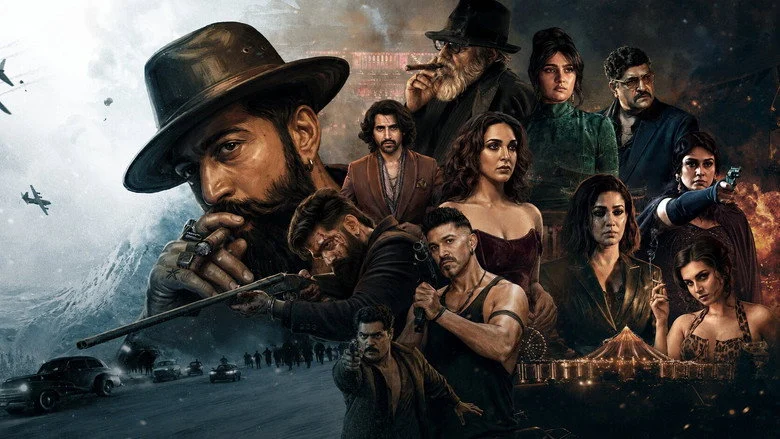
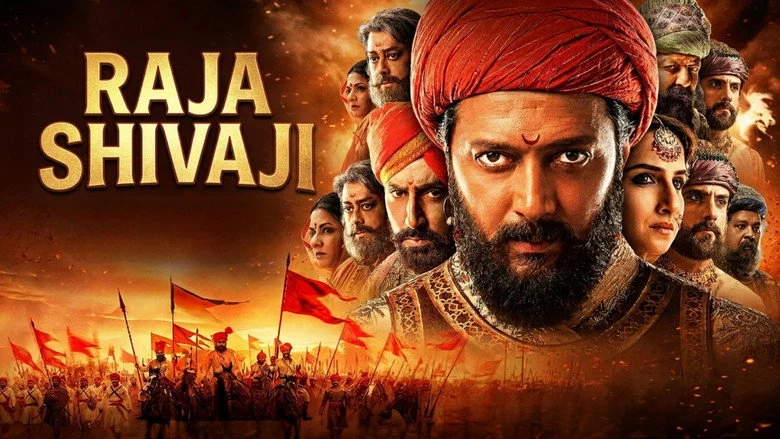
Raja Shivaji (2026): Riteish Deshmukh’s Second-Half Triumph Salvages a Slow Historical Setup


Shivaji’s younger brother lies dead at court, murdered on orders from a rival power, and the camera lingers on the face of a man who must now decide between grief and strategy. This is where Raja Shivaji finds its footing, when the film stops explaining its hero’s early consolidation of power and starts showing him respond to direct betrayal with calculated force. For nearly two hours before this moment, Riteish Deshmukh’s historical epic moves at the pace of a political ledger, more interested in territorial shifts than emotional truths.
The film’s ambition is undeniable. A 3-hour-and-7-minute period drama released across six Indian languages, with a cast spanning Sanjay Dutt, Abhishek Bachchan, Vidya Balan, and Boman Irani, Raja Shivaji arrives as one of the season’s most resource-intensive attempts at biographical war cinema. Yet between its architectural scale and its narrative delivery lies an uneven middle passage that tests patience before payoff arrives.
Deshmukh’s Authority Without Theatrics
Riteish Deshmukh carries the full weight of three-plus hours as Chhatrapati Shivaji, moving through phases of young strategic builder to embattled empire-holder. His performance avoids the trap of period-film grandstanding, instead anchoring itself in restraint, calculated pauses, measured speech, the careful bearing of a leader who must think several moves ahead of his opponents. In the second half’s confrontation material, particularly the Afzal Khan sequence, he finally finds material that matches his interpretive approach to the role.
Deshmukh’s Direction Tightens Only When Conflict Sharpens
As director, Deshmukh demonstrates clearer command once the Afzal Khan conflict narrows the film’s sprawling political scope into a single, urgent confrontation. The screenplay, credited to Deshmukh alongside Ajit Wadekar, Sandeep Patil, Prajakt Deshmukh, and Jaideep Yadav, suffers most from its chapter-based historical segmentation, each act feels obligatory rather than propulsive. Hindustan Times rated the film 3/5, noting that this epic drama, starring Riteish Deshmukh is more admirable than riveting, a judgment that lands most fairly on the entire first half’s machinery of setup.
The Afzal Khan Confrontation: When History Becomes Drama
The film’s strongest passage follows Shivaji’s strategic response to the murder of his brother Sambhaji Shahaji Bhosle and the resulting demand for revenge against Afzal Khan. This is where the chapter-based structure finally serves the story rather than splinter it. Sanjay Dutt’s Afzal Khan functions as the narrative’s anchor in this stretch, a single, clear antagonist who forces Shivaji’s hand and sharpens every decision into consequence.
The confrontation itself carries the weight of genuine opposition. Rather than a sprawling empire-versus-empire canvas, the film locks onto two opposing leaders whose immediate conflict carries both personal and political stakes. The staging emphasizes strategy as much as combat, letting the scene breathe as a moment of statecraft under pressure rather than pure spectacle.
What precedes this sequence, the political consolidation, the court intrigue, the early foundation of Swarajya, moves with the rhythm of a history textbook. Abhishek Bachchan’s Sambhaji and his death function primarily to generate revenge motivation, but the path to that moment sprawls across uneven emotional terrain. The film knows where it wants to land but takes unnecessary detours getting there.
Fans of period action cinema and Hindi-language historical drama can find substantial material here, particularly in the second half’s execution and the film’s commitment to multilingual presentation across Indian markets.
Bhagyashree and Genelia Deshmukh: The Domestic Spine
Bhagyashree, as Jijabai, grounds the film’s emotional foundation as Shivaji’s mother and moral anchor. Her scenes carry thematic weight, particularly when tied to the revenge arc following Sambhaji’s killing. Genelia Deshmukh appears as Saibai within the family-political support track rather than as a battlefield presence, a choice that keeps the domestic framing secondary to the historical machinery. Both performances signal the film’s interest in framing Shivaji’s rise as a family affair rather than an individual ascent.
Pacing Flaws Undercut Structural Ambition
The film’s dialogue work by Prajakt Deshmukh occasionally lifts proceedings, critics noted that the writing adds weight to key moments, yet inconsistent pacing prevents those moments from accumulating dramatic momentum. The chapter-based structure, meant to give historical progression clarity, instead fragments the narrative into episodic passages where emotional continuity breaks. The first half’s slower rhythm and weaker emotional engagement create a significant barrier before the film’s second-half payoff justifies the investment.
This is a film that works better if you arrive patient and stay focused through its political establishment phase. The Afzal Khan material and the retaliation sequences that follow deliver on the epic promise, but they demand you first accept nearly two hours of less riveting historical groundwork. For viewers committed to period cinema and willing to absorb the film’s segmented rhythm, there is substantive material here, particularly in the second half’s tighter construction and Deshmukh’s measured lead performance. For those seeking immediate narrative propulsion, Raja Shivaji tests that commitment across its first act before finding its footing.
Watch this on a theatrical screen where the battle staging and period design choices justify the production’s multilingual investment, though prepare for an uneven three-hour experience where patience pays off only after the midpoint.
Raja Shivaji (2026) is an admirable but uneven period epic that finds its drama only when confrontation replaces consolidation, I’d rate this film 2.5/5 for its ambitious scope held back by first-half pacing.
The biographical framing here shares thematic terrain with Michael review, another film wrestling with how to structure a hero’s rise within period constraints.
Both films echo the measured pacing of Rock 2026 verdict, prioritizing character authority over narrative momentum.