
Monkey In A Cage (2026): Anurag Kashyap’s Unflinching Look at Celebrity Accountability


A fading television star blocks his ex-girlfriend’s number and thinks the gesture will disappear into the digital void. Hours later, she walks into a police station and files a rape accusation. What unfolds is not a simple he-said-she-said, but a descent through institutional rot, where allegation becomes arrest, arrest becomes spectacle, and a man’s carefully curated public image collapses under the weight of his own private negligence.
Anurag Kashyap’s *Monkey In A Cage* arrives as a procedural thriller that refuses sentimentality. This is not the kind of film that lets its audience sit comfortably on either side of the accusation. Instead, it demands complicity from everyone, the accused, the accuser, the lawyers, the system itself, and watches as alliances fracture under pressure.
Bobby Deol’s Visible Unraveling Carries the Film’s Moral Weight
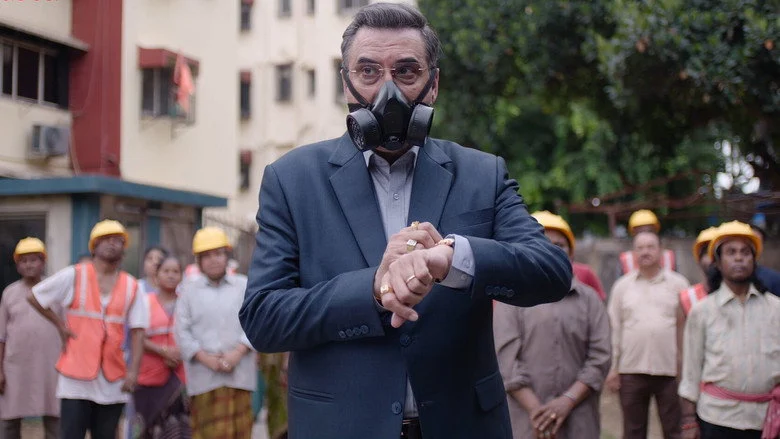
Bobby Deol inhabits Sameer Mehra as a man whose celebrity has taught him that consequence is negotiable. The character’s arc demands visible deterioration, from vanity to defensiveness to a fragile vulnerability he can no longer perform away. Deol sells the arrest sequence not as injustice, but as the first moment in years when Sameer cannot control the narrative around him. His blocking of Gayatri’s contact is casual cruelty dressed as boundary-setting, and the film makes him live inside that choice for 120 minutes.

Kashyap Builds Procedural Tension While the Legal System Corrodes Around His Protagonist
The director’s strength lies in treating the courtroom and police station not as venues for redemption but as zones of institutional compromise. Every character, prosecutor, defense, judge, operates inside a system designed to move money and power, not truth. His flaw is the film’s reliance on accusation as the primary engine of suspense. Once the rape claim lands, Kashyap never steps outside the procedural machinery long enough to let ambiguity breathe.
The Legal Procedural Unfolds as a Contest of Credibility, Not Justice
The narrative opens with personal disruption, a new relationship, an ex seeking re-entry, a blocked number, and pivots hard into arrest and institutional pressure. What makes this structure work is its refusal to separate Sameer’s behavior from the system’s corruption. He is guilty of arrogance and callousness toward Gayatri; the legal apparatus is guilty of every form of manipulation and compromise.
The scenes where allegation becomes official record are shot with clinical precision. No emotional swelling, no courtroom speeches designed to move the jury. Instead, procedural exchanges reshape alliances moment by moment. A lawyer becomes self-interested. A witness recalibrates loyalty. Every transaction is visible; every choice has a price.
The accusation sequence itself functions as the film’s inciting incident, but Films Fatale singled out the legal-procedural sections as the strongest part, noting Kashyap’s direct, tense treatment of sexual politics in the digital age. What elevates this beyond standard courtroom drama is the film’s willingness to implicate every institution, media, police, judiciary, in the erosion of truth itself.
Audiences drawn to crime thrillers with substance will find substantial material here across our Hindi Thriller reviews.
Sanya Malhotra and Sapna Pabbi Anchor the Personal Stakes in a System Run on Transactions
Sanya Malhotra as Khushi represents the present tense of Sameer’s life, the new relationship that complicates his collapse. Her presence becomes increasingly uncomfortable as the accusation unfolds, forcing her to choose between loyalty and self-preservation. Sapna Pabbi’s Gayatri functions as catalyst and mirror simultaneously. She is not a passive victim waiting for institutional rescue; she is a woman calculating how to weaponize her own powerlessness inside a system designed to protect men like Sameer.
The Film’s Subject Matter Ensures It Will Divide, Not Merely Entertain
A narrative centered on rape accusation, power imbalance, and celebrity untouchability arrives as socially contentious by design. The film offers no easy villains and no redemptive arc. Sameer is not wrongly accused; he is a man confronting consequence for the first time. The accusation itself is the point, not whether the system will justify or condemn him, but that both outcomes serve the same machinery of institutional indifference. This is uncomfortable viewing, which is precisely the point.
For viewers seeking substantive, topically urgent crime drama, *Monkey In A Cage* is a watch, but only if you can sit inside moral ambiguity without needing resolution. It’s a film that respects neither the accused nor the system meant to judge him. Watch it in a theater where the procedural dialogue lands with full weight; avoid it if you prefer straightforward narratives or lighter fare. Kashyap has crafted a procedural thriller that prioritizes institutional critique over character sympathy, and that restraint is its greatest strength.
Fans of Anurag Kashyap’s unflinching social examinations will recognize the thematic DNA shared by Mollywood Times review, which similarly tests characters under institutional and social pressure.
*Monkey In A Cage* is a sharp, procedurally tight examination of accountability and institutional rot that treats its subject matter with the gravity it demands, a 3.5 out of 5 crime thriller for viewers who want their thrillers to ask uncomfortable questions instead of providing easy answers.
Both this film and Maa Behen verdict use institutional and familial systems as pressure chambers, forcing characters to reveal themselves under duress.