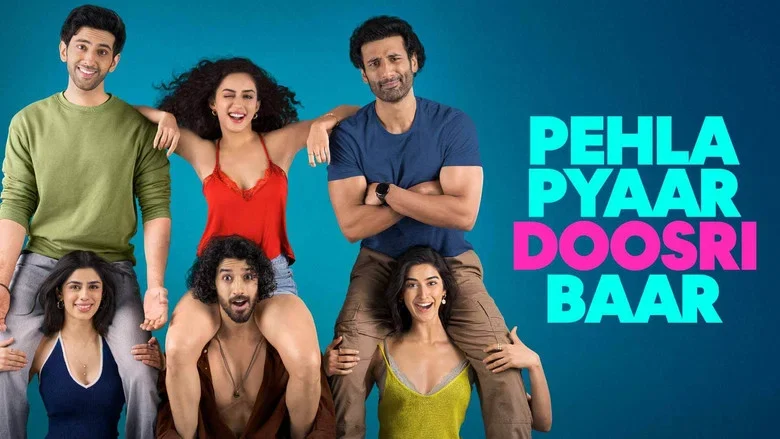
Pehla Pyaar Doosri Baar (2026): Sparsh Walia’s Reunion Rom-Com Fumbles Its Own Nostalgia
Three grown colleagues get drunk in Delhi and decide to chase their school crushes. It is a premise built for comedy, and for the first half hour, Anuj Saini’s film nearly earns it.
When Corporate Loneliness Becomes A Romantic Mission Statement
The film opens in the fluorescent purgatory of office targets and promotion anxiety. Gautam, Vedant and Shivi are single not by choice but by inertia, watching peers marry while their own lives stall at the desk.
What works here is the specificity of their desperation. The reunion trip is not a lark but a collective act of magical thinking, as if returning to the hills might reset the clock on everything they failed to become.
Saini stages the drunken decision with a loose, shambling energy that recalls the tonal looseness of Haiku, another recent release that mistook scattered charm for structure. The difference is that this film at least has a destination.
Three Romances, Three Different Kinds Of Disappointment
The Mussoorie section splits into parallel pursuits, and the screenplay’s intelligence lies in giving each thread a distinct failure mode. Gautam wants Gehna until she wants him permanently. Vedant wants Simran until her fiancé Vikesh materialises with a wedding date.
Shivi wants Karan so badly she remakes herself for him, only to discover that his attention was never the commitment she imagined. It is the film’s sharpest structural idea: three friends, three varieties of romantic delusion.
Where the film stumbles is in the execution of these reversals. Gautam’s retreat from Gehna plays as a familiar commitment-anxiety beat rather than a genuine psychological rupture, and the shift is telegraphed from the first intimate scene.
Sparsh Walia plays Gautam with a soft, self-deprecating hesitancy that works in the early scenes but cannot carry the weight of the film’s central emotional pivot. His stillness reads as blankness when the script needs conflict.
A Makeover Arc That Cannot Decide What It Is Saying
Shivi’s transformation is the film’s most problematic strand. Sargun Kaur Luthra brings a blunt, unguarded energy to the role, cursing freely and rejecting the “cute” label Karan assigns her.
But the screenplay never resolves whether her makeover is a critique of appearance-based validation or an endorsement of it. The “cute versus sexy” exchange lands as comedy, then curdles into something the film does not know how to handle.
Kunal Vaid’s Vedant carries the most conventional arc, and the arrival of Gobind Singh Mehta as Vikesh gives the second half a concrete deadline. Mehta plays the fiancé not as a villain but as an obstacle made of adult responsibility, which is the correct choice.
The emotional weight of Vedant’s pursuit recalls the quiet desperation in Orijinal, where romantic longing was grounded in tangible loss rather than nostalgia. This film reaches for that register but settles for wedding-day urgency.
The Hills Are Pretty, The Chemistry Is Not
Saini shoots Mussoorie with a postcard warmth that contrasts effectively with Delhi’s grey offices. But the visual nostalgia cannot compensate for the absence of genuine romantic friction between the central pairings.
The film’s music does much of the emotional labour, swelling at moments the dialogue cannot earn. It is a crutch, and a graceful one, but the reliance becomes visible by the third act.
The editing grows fragmented as the three storylines compete for resolution. Gautam’s commitment anxiety, Vedant’s wedding deadline and Shivi’s heartbreak all demand screen time, and none receives enough to land fully.
The comedy, meanwhile, is gentler than the premise suggests. This is not the aggressive banter of Udta Teer, which substituted volume for wit. The humour here is observational and low-key, which suits the material even as it undersells it.
A Producer’s Bet On New Faces In A Crowded Market
Luv Ranjan’s association as producer signals the commercial intention: a mid-budget romantic comedy built on fresh casting rather than star power. The bet is that audiences will accept newcomers if the premise delivers.
But the opening-day India net of roughly ₹0.22 crore suggests the bet has not paid off theatrically. In a market where romantic comedies increasingly compete with streaming content for the same demographic, a film without established leads needs either exceptional reviews or a distinctive hook.
This film has neither. Its three-protagonist structure is its best asset, but the marketing has not positioned it as an ensemble piece. It reads as a conventional romance, which it is not quite.
The broader landscape of contemporary hindi comedys has shifted toward franchise familiarity and star-driven vehicles. A newcomer-led reunion romance occupies an increasingly narrow niche.
The Final Verdict: Nostalgia Without The Courage Of Its Convictions
The film ends with the friends redirecting their energies toward Vedant’s mission, a collective act that suggests friendship as the real romance. It is a sweet idea, and a safe one.
What Pehla Pyaar Doosri Baar lacks is the willingness to sit in discomfort. Gautam’s retreat from Gehna should sting. Shivi’s heartbreak should bruise. Instead, both are softened by the film’s insistence on likability.
This is a film about adults discovering that first love was never about the other person. It just cannot bring itself to say so with any real conviction.