
Poniiy (2026): Ananya Raava Basu Anchors A Gentle Dog-Reunion Drama That Tests Your Patience
Shibesh Motilal’s camera finds its first image in the wet nose of a dog pressing against a child’s palm, and for a fleeting moment the theatre goes quiet. Then the film opens up into a search, and the quiet never quite returns.
A Girl, A Dog, And An Owner Who Vaporizes Off-Screen
The premise is disarmingly simple: a local family has been caring for Poniiy, but the dog belongs to a kind-hearted man who has vanished without explanation. Ananya Raava Basu’s young protagonist registers that absence the way children do, with a stare that lingers a beat too long at an empty doorway.
What the film does with that absence is where the trouble begins. The missing owner is treated less as a mystery to be solved than as a narrative excuse to move the girl and the dog from one location to the next, and Motilal rarely stops to let the emotional weight of the disappearance settle.
The Journey Structure Carries The Middle, But Barely
Once the girl and Poniiy leave the family compound, the film settles into a road-movie rhythm that borrows its beats from every animal-companion drama you have seen. There are kind strangers, minor obstacles, and long stretches of the dog trotting ahead while the girl follows, a visual motif that repeats without accumulating meaning.
Where the screenplay might have tightened the screws, it loosens them. The mystery of why the owner disappeared is dangled, then dropped for long stretches, then picked up again with little escalation. The film is content to let the search be the story rather than the consequence of the search.
This is a gentler proposition than the evidence-driven courtroom drama of Prahaar, which trusted its audience to track a procedural argument across two hours. Poniiy trusts its audience to feel something for a dog and a girl, and then asks them to keep feeling it without much narrative pressure behind the ask.
Ananya Raava Basu Holds The Frame, But The Frame Doesn’t Hold Her
Basu is the film’s most valuable asset and its most underused one. Watch her in the early household scenes: she doesn’t announce her attachment to Poniiy with dialogue. She does it by sitting on the floor with her back against the dog’s flank, her hand resting on its ribcage, her eyes on the adults who are deciding the animal’s fate.
That physical stillness is the performance’s best instinct. When the journey begins, however, the screenplay gives her little to do but look worried and walk. The girl’s determination is stated in the premise but rarely dramatized in a scene that forces her to choose something difficult.
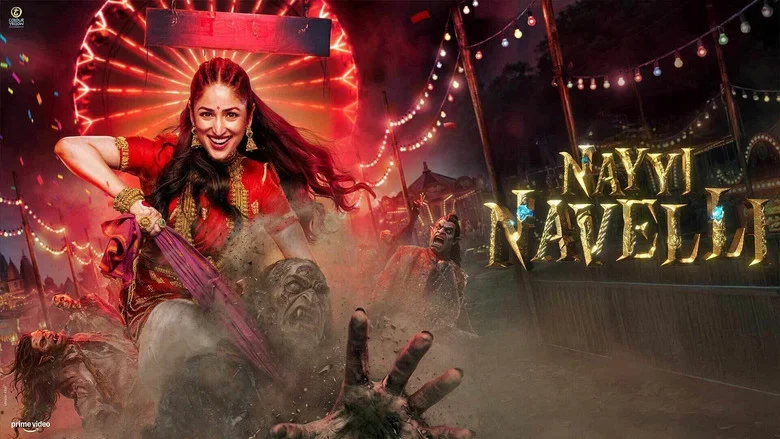
The contrast with the comic precision demanded of a performer in Nayyi Navelli is instructive. That film asked its lead to calibrate timing and tone across a tonal tightrope; this one asks Basu to carry emotional weight with almost no structural support beneath her.
Supporting Faces Without Supporting Functions
The adult cast is populated with recognizable names, but the film gives most of them nothing to do but react to the girl and the dog. Raju Kher, as one of the family elders, gets a single scene of quiet disapproval that registers because of his posture, arms folded, jaw set, eyes tracking the dog, and then the film forgets him.
Elsewhere, the ensemble functions as a texture rather than a set of characters. The village elders, the neighbors, the passersby on the road: they exist to populate the frame and occasionally offer a piece of information, but none of them acquire enough interiority to make the girl’s world feel inhabited.
Motilal’s Direction Finds Texture In Stillness And Loses It In Motion
The director’s best instincts show up in the film’s quietest passages. A scene of the girl washing Poniiy in a metal tub, the water going grey with dust, is shot in a single unbroken take that lets the animal’s patience and the child’s care become the drama. The lighting is flat, natural, and unshowy, and it works.
When the film moves, it loses that discipline. The journey sequences are cut with a restlessness that undercuts the emotional register, and Sudeep Banerjee’s camera, so attentive to faces in the domestic scenes, starts reaching for landscape compositions that feel generic rather than expressive.
The film’s dramatic instincts are closer to the grounded, performance-led register of Hanuman Ansh, which also asked its cast to carry uneven material through sheer presence. The difference is that the earlier film had stretches where the writing met the performances halfway; this one too often leaves Basu holding a scene alone.
What SP Media Is Betting On, And Whether The Bet Pays
SP Media is positioning Poniiy as a family-friendly theatrical release in a market that has grown suspicious of gentle dramas without a clear hook. The studio’s bet is that the human-animal bond, paired with a recognizable supporting cast, can pull in parents and children looking for something softer than the usual October slate.
That bet is reasonable on paper and risky in practice. The film has no franchise scaffolding, no star vehicle to anchor its marketing, and no obvious spectacle to justify a big-screen ticket over a streaming queue. Its commercial life will depend almost entirely on word-of-mouth from the family demographic it is courting.
Against the broader landscape of contemporary Hindi dramas, Poniiy reads as a modest, sincere swing rather than a calculated one. Whether that sincerity translates into footfalls is a question the opening weekend will answer more honestly than any advance material could.
The Reunion Lands, But The Film Around It Doesn’t Earn It
The climax, when it arrives, is staged with a restraint that is either admirable or evasive depending on your patience. Motilal resists the urge to wring tears from the reunion, letting the dog’s body language and the girl’s face do the work. It is the film’s most confident sequence.
But confidence in a single scene cannot compensate for a journey that never quite justifies its own length. The film ends on a note of quiet resolution that feels earned by the performers rather than by the screenplay, and that gap between performance and writing is the film’s defining tension.
Poniiy is a film made with care and carried by a young performer who deserves a sturdier vehicle. It asks you to believe in the bond between a girl and a dog, and Basu makes you believe it. What it never quite does is make you believe the journey was necessary.