Nayyi Navelli (2026): Yami Gautam’s Daayan Comedy Dares You to Trust the Perfect Bride
The most unsettling image in Balaji Mohan’s new film is not a shadow or a scream. It is a spotless kitchen in Meerut, and a bride who has just cleaned it without being asked.
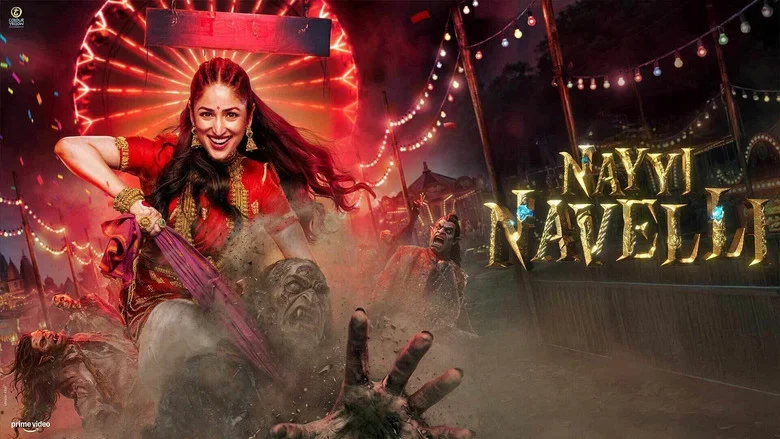
That is the joke, and the threat, of Nayyi Navelli, a Hindi fantasy-comedy that plants a suspected daayan inside a functioning joint family and lets the audience squirm on the sofa.
A Domestic Comedy That Weaponizes A Well-Swept Floor
Mohan opens on chaos: a Meerut household where relatives argue over tea, schedules collapse, and nobody agrees on anything. Yami Gautam Dhar’s Mohini walks in as the new bride and quietly fixes all of it.
The comedy lands because her competence reads as aggression to the people watching her. Every folded bedsheet and perfectly timed meal is a small territorial conquest, and the family’s relief curdles into unease at exactly the right pace.
What elevates the setup is that the film never asks you to laugh at superstition from a safe distance. It asks whether you would notice if your own home started running too smoothly, and whether you would be grateful or afraid.
The Brother-In-Law Who Refuses The Blessing
The screenplay’s engine is a single sceptic: the brother-in-law who treats the family’s sudden good fortune as evidence rather than luck. His suspicion is not noble curiosity; it is the panic of a man watching his own irrelevance get polished away.
Himanshu Sharma and Divy Nidhi Sharma’s writing gives him one escalating ritual of investigation, and the film’s most discussed beat arrives when he asks Mohini to show her feet. The folk logic is precise: a witch’s footprint is said to be reversed, and a reversed footprint is something you can check at the dinner table.
Balaji Mohan’s staging of that request is where the film earns its genre stripes. The camera holds on the family’s faces rather than the feet, so the horror lives in the collective decision to participate in the test.
It is the same instinct that gives the domestic material its teeth: the household is not a sanctuary from the supernatural, it is the instrument of the investigation. That inversion of the usual haunted-location grammar is what separates this film from the more conventional folk-horror theatrics that powered Ranabaali, which kept its fury at arm’s length from the family unit.
Yami Gautam’s Two Performances In One Body
Gautam has to play two roles without a costume change: the idealised bride the family wants, and the presence the brother-in-law fears. Her control is the performance, and the film’s tension comes from watching that control never crack, even when it should.
Her voice stays level in scenes where a normal person would raise it. When she finally drops the register in the reveal, the shift is physical rather than theatrical, a loosening of the shoulders that reads as a mask coming off.
The restraint recalls the coiled stillness Rajinikanth brings to his late-career work in Jailer 2, where menace is a matter of what the actor withholds rather than what he unleashes.
Around her, the ensemble functions as a single organism. Mita Vashisht’s Pinky Bua gets the film’s sharpest comic timing in the background of family meals, while Sushmita Mukherjee’s Dadi supplies the elder-generation gravity that makes the supernatural suspicion feel like a betrayal of tradition rather than a joke about it.
Where The Tone Starts To Slip
The film’s central gamble is tonal: domestic comedy, folk mystery and supernatural horror sharing the same rooms. For most of the runtime, the balancing act holds because the comedy and the dread are generated by the same action.
But the back half leans harder on revelation than on ambiguity, and the shift costs the film some of its earlier wit. Once the question of Mohini’s nature moves from suspicion to confrontation, the screenplay has fewer places to hide its mechanics.
The reported runtime discrepancy between cuts suggests some of that tightening happened in the edit, and the final stretch does feel like a film that decided to answer its own question rather than let it breathe.
That is a real cost, because the pleasure of the first hour was not knowing. The reveal is competent, but it converts a film about a family’s paranoia into a film about a monster, and the family becomes an audience.
The Fantasy Comedy Pipeline And What’s At Stake
Amazon MGM Studios and Colour Yellow Productions are betting that the Hindi fantasy-comedy can carry a theatrical release without a franchise name above the title. That is a genuinely risky proposition in a market where sequels and star vehicles dominate the calendar.
The film’s commercial logic depends on Gautam’s drawing power with family audiences and on the daayan premise travelling beyond the horror crowd. If it works, it opens a lane for mid-budget folk-fantasy comedies that don’t need a haunted haveli to sell tickets.
The comparison point is instructive: the fantasy-comedy space has recently produced films like Don't Trouble the Trouble, which charmed on performance but struggled to sustain its own premise across a full runtime. Nayyi Navelli faces the same structural risk, and its box-office ceiling will be decided by whether audiences reward the setup or punish the resolution.
This is the kind of mid-budget genre experiment that signals where contemporary hindi fantasys could go if the theatrical window holds, and it deserves a clearer verdict than the marketing has allowed so far.
The Verdict
Nayyi Navelli is a sharp, well-acted domestic comedy that understands its best weapon is a clean kitchen and a bride who never blinks. Yami Gautam Dhar carries the film’s dual identity with a control that makes the supernatural suspicion feel earned rather than imposed.
What holds it back from being a genuinely great genre hybrid is its reluctance to trust the ambiguity it built. The film spends an hour teaching you to fear perfection, then spends its climax explaining it, and the explanation is less interesting than the fear.
Still, there is a moment near the end, after the reveal, when the family sits in the same room they once shared with Mohini, and nobody speaks. That silence is the film’s real thesis: the horror was never the daayan. It was the possibility that the household preferred her to itself.