Mr. Lucky (2026): Raam Tej’s High-Concept Fantasy Thriller Runs on Borrowed Luck
A cap that flips a man’s fortunes becomes the whole movie. Harshith Rangaswamy’s shoestring fantasy thriller bets everything on one object, and very little on the man wearing it.
When Luck Becomes A Prop Instead Of A Problem
The premise arrives with a clean, almost mathematical appeal: Lakshman, an IT professional so chronically unlucky that “Lucky” plays as a cruel nickname, stumbles onto a mysterious cap that rewrites the probability of everything around him.
For roughly the first act, Rangaswamy lets that irony do the work. Raam Tej’s introduction leans into slouch and resignation, a man whose posture apologizes before he speaks.
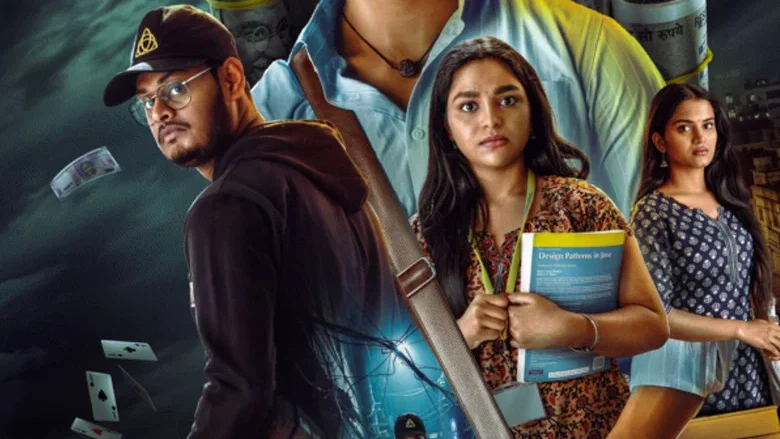
Then the cap arrives, and the film’s real gamble begins. The director has publicly framed the object as “both the hero and the villain, ” which is a genuinely sharp idea for a low-budget genre picture, no expensive antagonist required, just a piece of wardrobe with a body count of consequences.
But an idea is not a screenplay. The film treats the cap as a switch rather than a system, and a switch can only be flipped so many times before the audience starts asking what the rules are.
The Rules Are Missing, And So Is The Fear
Supernatural thrillers live or die on constraint. A cursed object is only frightening if we understand exactly what it costs, and Mr. Lucky keeps its ledger conspicuously blank.
Lakshman’s circumstances improve, the dangers compound, and the film moves toward a reckoning, but the mechanics stay vague enough that the tension never fully tightens. Compare the tighter spatial discipline Rangaswamy’s contemporaries bring to the same territory in Manduka, where a single psychological premise is allowed to dictate every camera position and every withheld reveal.
Here, the premise dictates the poster, not the staging. When the cap’s benefits turn dangerous, the film reaches for escalation without first establishing a baseline of dread, so the threat reads as plot development rather than genuine menace.
That gap is structural, not budgetary. A shoestring production can manufacture terror with a locked-off shot and a face; what it cannot do is skip the rulebook.
Raam Tej Carries The Weight, But The Script Won’t Share It
The lead performance is the film’s most persuasive asset. Tej is at his best in the quiet, physical beats of the before-and-after, the way his shoulders drop when fortune turns, the flicker of greed he lets cross his face before he can suppress it.
There’s a watchful, second-guessing quality in his stillness that recalls the identity-fracture anxiety of KillR, where the performance had to hold a shifting self together while the plot pulled it apart. Tej is doing similar work here, and the camera rewards him in close-up.
What he cannot do is act opposite a hat. The supporting ensemble, Rithi Shetty among them, is given presence without function, hovering at the edges of scenes that need them to apply pressure and instead let Tej monologue into the void.
One supporting turn from a director-turned-actor in a key role carries real screen energy in his few minutes, but the film never builds a scene around him. The relational drama that should ground the fantasy stays theoretical.
The Silence That Should Have Been A Threat
Rangaswamy shoots with an economy born of necessity, sixteen days, patchwork included, and there are passages where that compression works in the film’s favor, forcing the camera to hold on faces rather than cut away.
But the audiovisual grammar never distinguishes between good luck and bad. The same warm light, the same mid-tempo score, the same medium shot greet both the cap’s gifts and its costs, so the audience has no sensory cue that something has gone wrong.
The screenplay’s linear structure, misfortune, discovery, improvement, consequence, is sound enough on paper. On screen, the second half accelerates toward a climax that the first half never earned the right to deliver.
This is the same trap that swallowed the atmospheric ambitions of Tadviruddha, a film that mistook sustained mood for accumulating stakes. Mr. Lucky at least has a prop with a pulse; it just doesn’t know when to squeeze.
A Sixteen-Day Shoot With A Two-Hour Problem
The production story is genuinely appealing: a former IT professional turned filmmaker, a Bengaluru street vendor turned lead actor, a compressed schedule that forced invention. That backstory deserves the goodwill it generates.
It does not, however, excuse a two-hour runtime that behaves like ninety minutes of idea stretched across a feature.
The film’s central metaphor, luck as an external force with a moral invoice, is the kind of premise that contemporary Kannada thrillers have been circling for years, and this one lands closer to a sketch than a statement.
The consequences of Lakshman’s transformation are gestured at rather than dramatized, which leaves the ending’s moral weight curiously unclaimed. What should feel like a reckoning plays as a resolution.
The Box-Office Math Of A Cap And A Prayer
With no verified opening-day figures and a release that barely registered in trade tracking, Mr. Lucky enters the market as a curiosity rather than a contender. The producing banners have kept the budget lean enough that the downside is contained, but containment is not a strategy.
The real question is theatrical leverage. Raam Tej is not yet a name that opens a weekend, and a high-concept fantasy thriller without star wattage or a marketing hook beyond its own gimmick has a narrow window before streaming absorbs it.
The regional remake pipeline and the festival-driven indie circuit offer two very different futures for films like this one. Neither is guaranteed, and the cap, charming as it is, is not a franchise.
A Reckoning The Film Never Quite Delivers
What lingers after Mr. Lucky is not the cap’s menace but the sense of a filmmaker who found the right object and then lost faith in it. The film’s final movement wants to say something about the price of borrowed fortune, but it settles for saying that fortune is borrowed.
That’s a thesis, not a climax. And in a genre where the audience must feel the invoice before they see it, a thesis is the one thing a cap cannot buy.
Rangaswamy has the instincts, the economy, the eye for a face in close-up, the willingness to build a movie around a single idea. What he needs next is a script that treats its own premise as a threat rather than a premise.