Khushi – The Princess of the Jungle (2026): The Princess of the Jungle (2026): Suraj Venjaramoodu’s Narration Can’t Mask a Forest Without a Villain
The forest glows, the animals chatter, and a child understands every word of it. What the film never supplies is a reason to fear for her.
A Children’s Day Gift That Forgets To Threaten Its Own Heroine
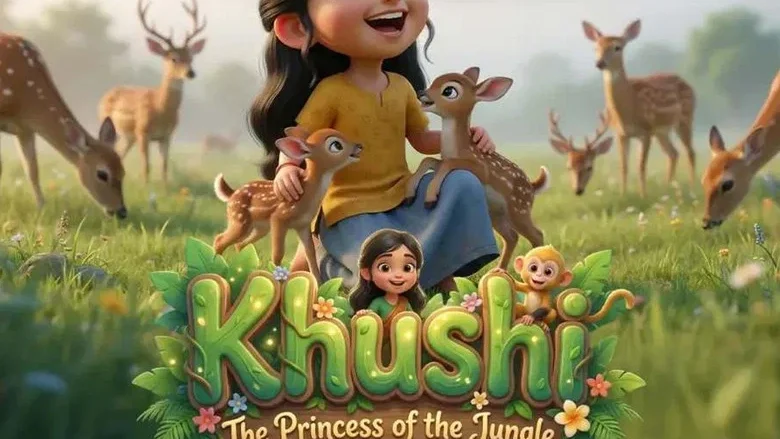
ManoramaMAX has built its Children’s Day offering on a single, generous idea: an eight-year-old girl who can speak to animals. Khushi wanders into a hidden grove with her younger brother Chottu, and the world opens up in shades of neon foliage and talking creatures.
The premise is warm, specific, and aimed squarely at viewers between four and twelve. The trouble is that warmth without friction becomes wallpaper, and the film’s opening act coasts on discovery alone.
When Nobody Wants To Harm Anyone, The Quest Has Nowhere To Go
Khushi’s journey with Bundu the monkey, Tara the elephant calf, and Golu the porcupine rolls forward on curiosity rather than consequence. There is no named antagonist, no logging baron, no shadow pressing at the treeline.
Children’s animation does not require a snarling villain to work. It requires the sense that something precious can be taken away. This screenplay keeps its threats abstract, a vague unease about the forest, a lesson about respect, and so every encounter lands with the same gentle weight.
Compare the spatial discipline on display in Sooriyan Maraindha Maalai, another recent release that understands how confinement and stillness generate pressure. Here the forest is endlessly open, and openness turns out to be a liability.
Suraj Venjaramoodu Narrates Like A Grandfather Who Trusts The Pictures
The veteran actor’s voice work is the production’s steadiest asset. He settles into a low, unhurried register, letting sentences trail off at the edges of a scene rather than pushing them forward.
It is a narration of confidence, not urgency. When a glowing creature drifts across the frame, his tone drops into wonder; when the children bicker, he steps back entirely and lets the animation carry the beat.
That restraint is admirable and also revealing. A narrator this relaxed is compensating for something, a visual track that rarely escalates. His work in the recent Lambodhara 2.0 shows a performer unafraid of comic excess, and the contrast here is stark.
Two Children, Three Species, And A Blocking Problem
Chottu exists as a younger-brother counterweight, and the animation gives him a specific physical vocabulary, he lags a half-step behind Khushi, tugs at her sleeve, stumbles over roots. That lag is the film’s best characterisation.
The animal companions fare less well. Tara’s scale is used for one or two gentle gags, Golu’s quills register as texture, and Bundu gets the bulk of the physical comedy without ever developing a temperament beyond mischief.
The ensemble is diverse on paper and interchangeable in motion. Species variety substitutes for personality, which is the sort of shortcut that works on a first watch and evaporates on a second.
AI-Assisted Production And The Uncanny Flatness At The Edges
The film is being positioned as Malayalam’s first AI-produced children’s original, and the technical identity is visible in the frame. Background foliage has a uniform density; light falls on leaves without the irregularity of hand-painted texture.
Where the pipeline succeeds is in the fantasy register, glowing fauna, drifting spores, a canopy that reads as genuinely alive. Where it falters is in character faces during dialogue, which hold expressions a beat longer than the emotion requires.
None of this will trouble a seven-year-old. It will trouble the parent sitting beside them, and that parent is the one holding the remote.
The Fantasy Shelf Is Crowded, And This One Arrives Without Teeth
The ambition of a Malayalam-language children’s fantasy deserves acknowledgment, and the ecological framing, curiosity, empathy, respect for living things, is delivered through adventure rather than lecture.
But the genre has recently produced work with far more nerve. The divine weight and unresolved grandeur of Ramayana demonstrates what mythic stakes can do for young audiences; this film declines to raise its own.
That hesitation is the whole problem. A forest adventure without a threat is a nature walk with better lighting.
ManoramaMAX’s Streaming Bet And The Cost Of Playing It Safe
The platform is the producer here, and the calculus is legible: a low-risk, culturally specific children’s title that anchors a holiday weekend and requires no theatrical footprint. For a streamer building a family slate, that math holds.
What it does not build is a franchise. Animated children’s properties live or die on rewatch value, and rewatch value requires a memorable antagonist, a song that sticks, or a character a child will ask for by name.
This film offers a pleasant afternoon and no return ticket. Across contemporary Malayalam fantasy, the titles that endure are the ones willing to frighten their audience just enough.
The Forest Is Safe, And That Is The Disappointment
Khushi ends where she began, in a world that welcomed her, taught her something gentle, and never once tried to take it away. For four-year-olds, that is a soft landing. For anyone older, it is a missed opportunity.
A princess of the jungle should have something in the jungle worth defending against. This one rules a kingdom with no borders, no enemies, and nothing at stake.