Party Animals (2026): Viraj Ghelani Anchors a Farce That Runs on Fumes
The school PA system crackles, and a boy turns his best friend’s private crush into a public broadcast. That single act of loyal sabotage tells you everything about the friendship at the center of Ravi Chhabria’s Party Animals, and about the film’s willingness to trade character for spectacle.
A Childhood Confession Sets a Bar the Adult Film Never Clears
The opening flashback is the sharpest thing in the picture. Mann Patel (Viraj Ghelani) hijacks the school intercom so Armaan Khanna (Arjun Tanwar) can declare his love for Simran to an entire campus, and in ninety seconds the film establishes both temperaments: Mann the improvising instigator, Armaan the privileged boy who needs someone else to press the button.
Years later, the contrast hardens into class geometry. Armaan is prepped for a hero launch bankrolled by his father’s film money; Mann manages his father’s farsaan shop and organizes a New Year’s Eve party for Mumbai’s fashionable set to prove he belongs in the same frame.
The premise has genuine comic potential. The execution rarely trusts it.
Every Attempted Fix Manufactures a Louder Problem
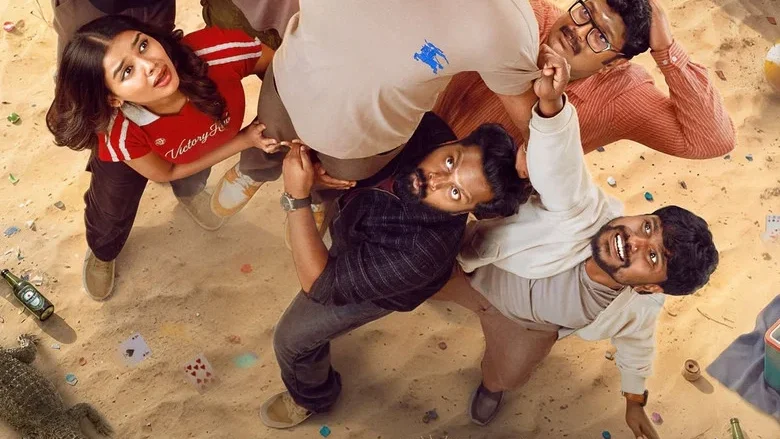
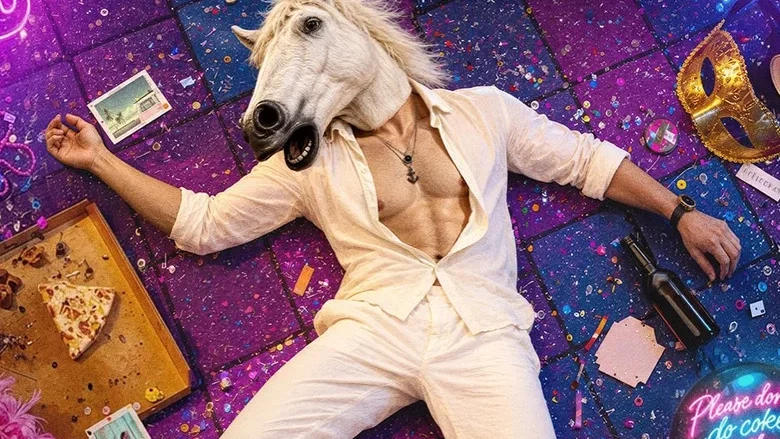
The engine of the film is chain-reaction farce, and Chhabria commits to it with almost mechanical discipline. A nightclub leads to a mansion party, which leads to an open double-decker bus, which leads to goons, cops, a jail cell and, in the film’s most desperate flourish, a runaway horse.
Each solution generates a worse crisis. That is a legitimate comic structure, and for a stretch the spatial escalation carries real momentum, much as the tighter spatial discipline in Appa Kutty showed how controlled geography can manufacture tension without decorative camera moves.
But escalation is not the same as progression. Around the party-bus sequence the mishaps stop compounding and start accumulating, each new disaster erasing the memory of the last rather than deepening it. At two hours and thirteen minutes, the mechanism visibly wears out before the film does.
Ghelani Carries the Comic Load; Tanwar Stands in Its Shadow
Ghelani is the reason the first half breathes. Watch his posture shift between the farsaan counter and the party floor, shoulders squared, chin lifted, a man performing a version of himself he can’t yet afford.
His timing on the intercom flashback is loose and reactive, playing off the silence of the crowd rather than pushing through it.
Tanwar’s Armaan is the harder assignment and the thinner result. He plays the wealthy heir with a pleasant, recessive stillness that works in the romantic scenes with Jaanya Joshi’s Simran but leaves a vacuum whenever the comedy needs a second engine. The film keeps asking him to react; he keeps obliging politely.
The supporting ensemble, party guests, cops, goons, functions as weather rather than characters, arriving on cue to raise the temperature and departing without residue.
The Camera Keeps Up, Which Is Not the Same as Keeping Control
Chhabria’s staging favors the wide and the busy: packed dance floors, bus aisles, street corners crowded with uniforms and fists. The visual logic is documentary-adjacent, keeping bodies in frame and letting chaos fill the edges, and it suits the material better than any slicker approach would.
What’s missing is rhythm. The film has no interest in the held beat, the pause that lets a gag land before the next one detonates, the kind of restraint that made the silence-first horror architecture of Kaali Kheti so unnerving. Here the noise is continuous, and continuous noise flattens into texture.
By the jail-cell stretch, the audiovisual assault has become the film’s entire argument. The runaway horse is the tell: a gag deployed because the film has run out of escalation and reached for absurdity instead.
Yoodlee’s Bet on a Creator-Led Debut Is a Calculated Risk
Yoodlee Films, Saregama’s production arm, is wagering on Ghelani’s digital fanbase converting into theatrical footfall for a mid-budget adult comedy. That’s a coherent strategy in a market where creator-led debuts have outperformed their budgets, but it depends on word of mouth surviving opening weekend.
The A certificate narrows the addressable audience to adults, and the nightlife-heavy setting offers no family-viewing hook. Without verified box-office figures, the commercial verdict remains genuinely open, but the exhibition math on a loud, long, mixed-reviewed farce is unforgiving.
The film’s real competition isn’t other comedies; it’s the streaming queue, where viewers can sample the friendship premise without committing to the full runtime.
A Friendship Comedy That Forgets to Protect the Friendship
The ending arrives with the characters changed, though the film is vague about what the change costs them. That vagueness is the real failure, not the repetition, not the runtime, but the refusal to let the night’s chaos leave a mark on the bond it spent the opening scene so carefully establishing.
The genre sibling that got this right, Parivarik ManuRanjan, at least understood that comedy settles into character. Party Animals settles into incident.
There’s a version of this film, maybe twenty minutes shorter and one rewrite deeper, where Mann’s hunger to belong and Armaan’s inherited ease collide into something genuinely funny and a little sad. That version never quite arrives.
What we get instead is a party that never ends and a friendship we’re told about rather than shown. Ghelani deserves a better vehicle; the audience deserves a shorter night.