
Maya lady (2026): Rakesh Varre Anchors A Romance That Loses Its Nerve
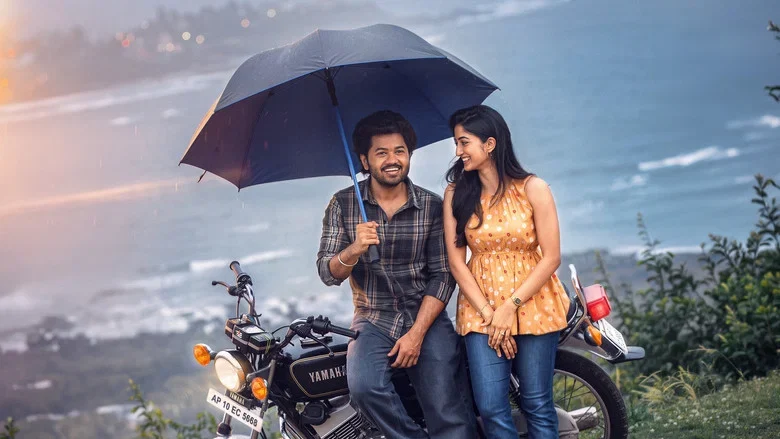
Rakesh Varre’s Krish walks into the frame with the coiled stillness of a man who teaches other people how to absorb a blow, and the film’s best joke is that none of that training survives contact with Madhumita Sarcar’s Asha.
For roughly an hour, Maya Lady plays as a Vizag-set romantic comedy with a behavioural quirk at its centre; then the floor gives way into possession and concealment, and the film never decides whether it wanted to fall or was pushed.
The Man Who Teaches Self-Defence And Cannot Defend Himself
The premise is genuinely elegant on paper. Krish runs self-defence classes; Asha’s defining habit is returning lost objects to their owners, a small moral gesture that reads as gentleness until the film starts asking what she keeps instead of what she gives back.
Varre plays the early courtship with a loose, unforced physicality, all easy shoulders and teacherly patience, and the contrast between that and his later rigidity is the performance’s clearest throughline.
The film’s structural intelligence lies in giving Krish an antagonist his fists are useless against. Roopa keeps arriving, keeps refusing to leave, and the screenplay’s smartest move is to make her persistence feel less like villainy than like weather.
Roopa Arrives Too Often And Explains Too Little
Here is where the film’s confidence curdles. Roopa’s intrusions are staged as comic collisions in the first act and as dread in the second, but the tonal bridge between those registers is never built, so the audience is asked to laugh and flinch at the same behaviour without the film earning the shift.
Madhumita Sarcar does the heavy lifting with restraint. Asha’s refusals to discuss her past are played as polite deflection rather than mysterious withholding, a woman changing the subject at a dinner table, not a femme fatale in waiting, and that ordinariness is the most unsettling thing in the movie.
The supporting ensemble, largely unnamed in the marketing and given little to do on screen, drift through scenes as texture rather than pressure; the film keeps its dramatic weight entirely on three bodies and occasionally buckles under the load.
A Love Triangle That Forgets To Be A Triangle
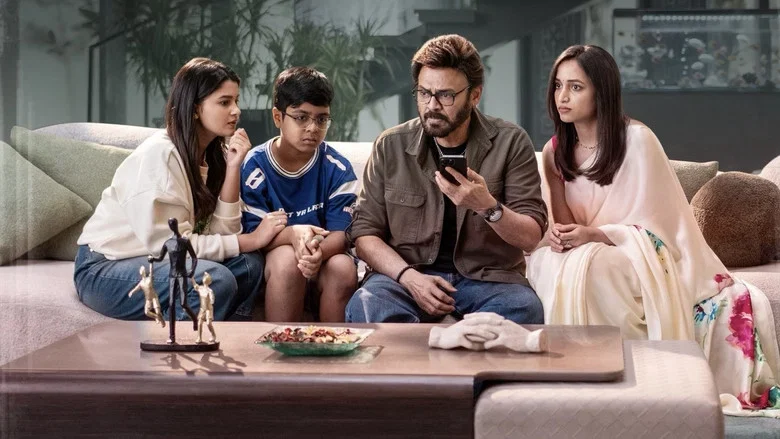
The middle stretch is the film’s most disciplined passage and also its most frustrating. Krish oscillates between two women, but the screenplay treats his indecision as plot rather than character, so we watch him react to Roopa’s arrivals instead of watching him choose.
The film’s tonal pivot from sweetness to danger is the same manoeuvre that recent Telugu comedies have attempted with more visible structural control, and the comparison is not flattering; where Cocoons at least committed to its puzzle logic, this one keeps hedging its genre allegiances until the third act.
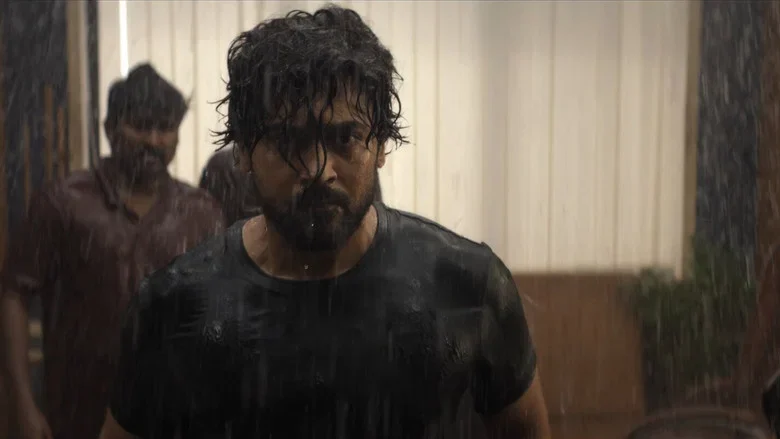
What saves the midsection is Varre’s physical discipline. Watch him in the confrontation scenes: he plants his feet like a fighter, then visibly forgets the stance when Asha speaks, and the small collapse of posture does more narrative work than any line of dialogue.
Vizag Photographed As A Mood, Not A Place
The coastal setting is used for texture and little else. The camera favours mid-shot compositions that keep all three principals in frame, which serves the triangle but flattens the city into a backdrop of salt light and tiled terraces.
Pacing is the more serious problem. The first half ambles through courtship beats with a relaxed rhythm that suggests confidence, then the second half accelerates into revelation without giving the audience room to feel the betrayal land.
The film’s craft instincts are competent rather than distinctive, clean blocking, unshowy cutting, a score that tells you exactly what to feel and when, and that very competence is what makes the missed opportunities sting.
There is a version of this material that trusts silence, that lets Asha’s evasions sit in a room without musical accompaniment, and that version would be considerably more unnerving than the one on screen.
What The Ending Refuses To Say
Krish’s final reckoning is staged as an emotional rather than physical test, which is the right instinct, but the resolution arrives with a tidiness that contradicts everything the film has built about the unknowability of the women around him.
The closing question, which woman did he actually fall for, is posed but not truly answered, and the ambiguity reads less like deliberate open-endedness than like a screenplay that ran out of conviction at the moment it needed the most.
It is worth noting how much sharper this could have been with the tonal discipline of Titanic, a peer release that at least understood that romantic comedy and romantic dread require different rhythms of silence.
The Exhibition Math On A Mid-Budget Telugu Romance
The producing banners have staked a mid-budget Telugu release on a star who is more familiar as a character actor than as a solo lead, and that calculus depends entirely on word-of-mouth surviving the opening weekend.
The film’s genre ambiguity is a commercial liability, not an asset; audiences who arrive for a breezy romance will feel sold a thriller, and audiences who arrive for a thriller will find the first hour too gentle to satisfy.
Varre’s theatrical leverage is real but narrow, he carries the frame with authority, and his presence is the single most reliable element in the marketing, but a lead’s charisma cannot substitute for a film that knows what it is.
The broader landscape of contemporary Telugu comedies is crowded with films that commit harder to their tonal gambles, and this one’s refusal to pick a lane will cost it at the box office more than any single weak scene.
What the film does have is a genuine curiosity value: a star vehicle that treats its female lead’s interiority as a plot mechanism rather than a decoration, which is rarer in this budget bracket than it should be.
The performances, particularly Sarcar’s quiet refusal to play mysterious, carry the film further than its screenplay deserves, and that gap between execution and material is the most interesting thing about it.
There is also the small matter of a film that asks its hero to solve a problem his body cannot solve, and then gives him a solution that is essentially a shrug, a thematic gamble that the direction does not quite have the nerve to see through.
In the end, Maya Lady is a film that flinches at its own premise. It has the architecture of a psychological romance and the nerve of a middling date movie, and the gap between those two things is where the whole enterprise quietly deflates.
Varre deserves a vehicle that trusts him to hold a frame in silence; Sarcar deserves a screenplay that lets her character’s evasions mean something. What they have here is a promising sketch of both, and a finished film that is neither.