Sooriyan Maraindha Maalai (2026): Sacchin Nachiappan Anchors A Chamber Romance That Tests The Limits Of Stillness
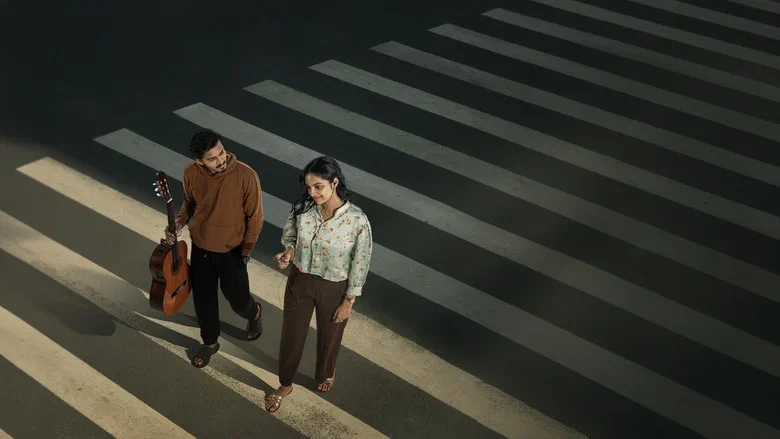
The lights go out across Chennai, and two strangers are left on a terrace with nothing to look at but each other. Eashwar Gopala Krishnan builds an entire film on that enforced proximity, and for a while the constraint is the point.
A Blackout Romance That Refuses To Manufacture A Villain
There is no antagonist here, no betrayal waiting in the stairwell, no third act confession. The opposition is creative frustration and the low hum of a career that has quietly stalled.
Sacchin Nachiappan plays a freelance illustrator; MV Namritha plays a music director whose work has gone nowhere. The film asks whether two people with unfinished professional lives can say something true to each other while the city’s power grid is down.
That is a genuine dramatic idea, and the film’s refusal to import external conflict deserves respect. It also creates the film’s central problem, which the running time never fully resolves.
When Silence Is The Only Tool In The Room
The terrace does the work of a third character, and the film leans on it heavily. Generator hum replaces traffic noise, distant voices drift up from balconies, and the sky moves from sunset to full dark.
That soundscape is the most disciplined element on screen. The director strips away the electrical clutter of urban life and lets the characters hear each other for the first time.
But a chamber piece lives or dies on the quality of its pauses, and the screenplay treats silence as a mood rather than a mechanism. Awkwardness is established early and then repeated rather than deepened.
The transition from silence to conversation is the film’s whole engine, and it needs a sharper gear shift than the material supplies. The peer release Lambodhara 2.0 faced a similar problem of sustaining a single idea across a compressed runtime, and both films show how thin a premise can get when the writing coasts on atmosphere.
Two Performers Learning To Share A Frame
Nachiappan’s illustrator is a study in physical reticence. He keeps his hands in his pockets, angles his shoulders away from his scene partner, and looks at the skyline when he should be looking at her.
It is a smart choice for a character whose work is solitary and whose instinct is to retreat. The performance earns its small shifts rather than announcing them.
Namritha has the harder assignment, because her music director must push the conversation forward without seeming to force it. She does her best work in the middle stretch, when her voice drops and she stops performing composure.
The chemistry between them is real but intermittent, which is honest for two strangers and risky for a film with nothing else to cut to. The performance foil here is instructive: the romantic restraint on display in Maya lady shows how quickly tenderness turns inert when the screenplay mistakes hesitation for depth.
What The Camera Does With A Single Terrace
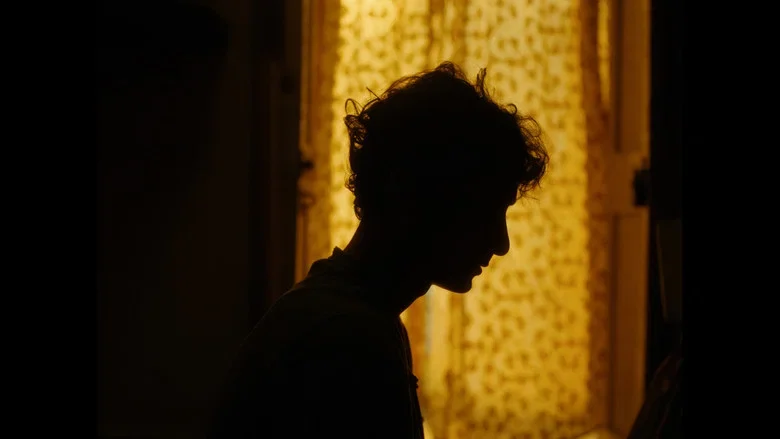
The visual scheme is built on reduced illumination, and the film uses the dark honestly. Faces are lit by whatever the building offers rather than by a cinematographer’s vanity source.
Framing stays close and patient, letting the two figures occupy opposite edges of the terrace before slowly drawing them toward the middle. It is a legible geometry of approach.
Where the direction falters is in variation. The same two-shot rhythm recurs, and by the final third the eye has stopped finding new information in the composition.
AKR’s score is used sparingly, which suits the material, though the film’s in-story connection to music never pays off in a scene where we actually hear the music director’s work. That feels like a missed opportunity rather than a deliberate withholding.
The broader movement toward intimate, dialogue-led Tamil storytelling is clearly in ascent, and this film sits comfortably within that contemporary Tamil dramas wave even as it tests how far minimalism can stretch.
A Third Character Who Never Arrives
Arun Krishnan is listed among the cast, but on screen his presence registers as a credit rather than a dramatic function. Whatever role he was meant to serve in the evening’s architecture, the film never builds it into the encounter.
That absence matters. A brief interruption from the outside world, a neighbor, a phone call, a returning resident, could have cracked the terrace open and given the two leads something to react against.
The film chooses hermeticism instead, and the choice costs it a layer of texture it could have used. The thematic sibling Angelina shows how a single confined night can be made to breathe by letting the outside world intrude at the right moment.
The Runtime Problem Nobody Has Resolved
Listings disagree on whether this is a 43-minute film or a 62-minute one, and that discrepancy is not trivia. It speaks to a production that has never quite settled on its own shape.
Watching it, the shorter figure feels closer to the truth. The evening’s arc from accidental meeting to emotional recognition is complete, but it is thin, and stretching it further would only expose the padding.
What the film gets right is the resolution’s modesty. Nobody declares love, nobody promises to call, and the recognition between them is small enough to believe.
What it gets wrong is the road there. The middle stretch repeats its own discoveries, and the screenplay never finds a second register to complement the first.
A Small Release In A Market That Wants More
This is a limited-release Tamil title with no verified production banner, no reported opening-day figures, and no trade analysis to speak of. It arrives without the machinery of a studio push behind it.
That absence shapes the commercial reality more than any creative decision. A 43-minute chamber drama with two unknown leads has almost no theatrical runway in a market built on star vehicles and event releases.
Nachiappan’s box-office leverage remains unproven, and this film will not change that. Its natural home is a streaming platform that can position it as a short-form character piece rather than a theatrical proposition.
The Verdict: A Quiet Experiment That Earns Its Stillness Only Partly
Eashwar Gopala Krishnan has made a film about the difficulty of saying something honest to a stranger, and he has made it with real formal discipline. The blackout is not a gimmick here; it is a genuine dramatic condition.
But discipline is not the same as depth, and the film mistakes restraint for revelation in its final stretch. The evening ends where it should, but the journey there needed one more turn of the screw.
What lingers is not the dialogue but the image of two people on a dark terrace, listening to a city that has briefly gone quiet. That image is worth the ticket, even if the conversation never quite matches it.