
Aakasamlo Oka Tara (2026): Dulquer Salmaan Anchors a Sincere, Predictable Ascent
Pavan Sadineni opens on a village girl staring at a passing astrovan, and the film never quite recovers from the beauty of that first image. What follows is a two-hour-thirty-nine-minute climb toward the stars, powered by a performance that deserves a sharper screenplay.
When a Wedding Night Becomes a Moral Indictment
The film’s most electric sequence arrives early. Krishna, a middle-class driver, discovers on his wedding night that his bride is sixteen and dreams of becoming an astronaut.
Sadineni stages the revelation with a stillness that is genuinely unnerving. The camera holds on Dulquer Salmaan’s face as confusion curdles into a quiet, unshakeable guilt.
It is a scene that could have curdled into melodrama. Instead, the director lets the silence do the moral accounting, and the film briefly becomes something rarer than an inspirational drama: a study in complicity and its refusal.

The District Topper and the Machinery of Convenience
Kalpana’s exam results arrive as a narrative crowbar. The district-topper revelation converts her from a child bride into a quantifiable asset, and Krishna’s support becomes the film’s engine.
Here the screenplay, credited to Gunnam Gangaraju and Vasanth Jurru, finds its most persuasive argument. Krishna’s sacrifice is measured in overtime shifts, depleted savings and the quiet surrender of his own ambitions.
That material grounding distinguishes the film from the more romanticized support systems of Bachelor Party D'eux, where male camaraderie functions as texture rather than economic scaffolding. The difference is instructive: one film treats support as atmosphere, the other as labor.
Yet the screenplay’s second half begins to coast. Once Krishna commits, the obstacles arrive on schedule, and the audience can predict the emotional temperature of every subsequent scene.
Satvika Veeravalli’s Wide-Eyed Precision
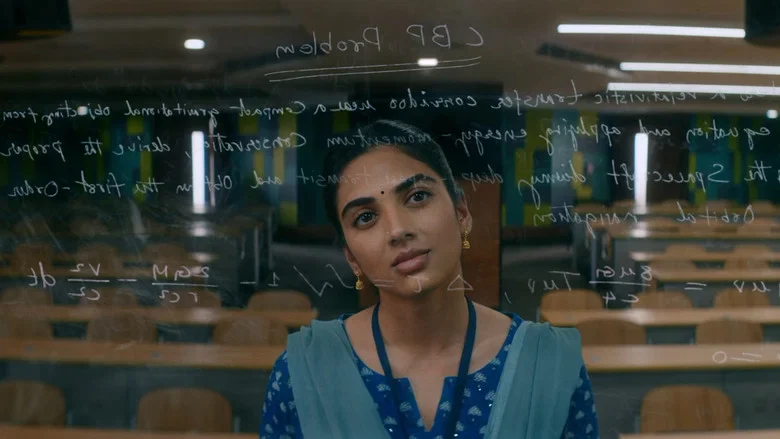
The debutant carries the film’s tonal contradictions on her face. In the classroom scenes, she plays Kalpana’s intelligence as a kind of quiet stubbornness, eyes fixed on the blackboard with the intensity of someone hoarding a secret.
When she speaks about space, her voice drops half a register. It is a small choice, but it separates the schoolgirl from the dreamer, and it keeps the character from collapsing into a single note of victimhood.
Dulquer Salmaan, meanwhile, works in the register he has refined across his career. The warmth he brought to the more uneven romantic terrain of I'm Game returns here, but stripped of showmanship.
His Krishna listens more than he speaks. When he watches Kalpana study, his face registers a complicated pride, part paternal, part spousal, entirely unresolved.
The Reconciliation Problem: When Hostility Dissolves Too Cleanly
The film’s final act commits its most significant error. The abusive father apologizes. The hostile sister-in-law softens. The village that treated Kalpana’s ambition as a scandal suddenly claims her as its own.
None of these reversals are dramatized with sufficient friction. The father’s apology arrives as a plot requirement rather than a psychological reckoning, and the community’s embrace feels less like earned redemption than narrative bookkeeping.
This is where the film’s social drama ambitions thin out. The patriarchal structure that the first act indicts with real severity is ultimately asked to do nothing more than applaud.
Compare this to the more patient examination of social pressure in ENE Repeat, which refuses to let its characters off the hook so easily. Sadineni’s film wants the catharsis without the confrontation.
Pacing, Texture and the Weight of Two Hours Thirty-Nine
Sadineni directs with a clean, legible visual grammar. The rural domestic spaces are framed with a low ceiling of oppression, doorframes that dwarf Kalpana, rooms that seem to exhale heat.
The astrovan functions as the film’s single most effective visual motif. It appears at moments of possibility, a flash of metal against the village dust, and then disappears.
But the runtime works against the material. The motivational beats begin to repeat, and the second half loses the sharp dramatic turns that made the first act compelling.
The film’s earnestly straightforward approach to education and aspiration signals a broader appetite for socially grounded drama across contemporary Telugu dramas, even when the execution settles for the familiar.
The Commercial Arithmetic of a Sincere, Mid-Budget Aspiration
Produced across the Geetha Arts, Swapna Cinema and Lightbox Media banners, the film arrives with the kind of mid-budget prestige positioning that rewards family audiences and awards-season attention.
Dulquer Salmaan’s theatrical leverage remains strongest in the Telugu-dubbed market, where his presence functions as a trust signal rather than a mass-opening guarantee. This film tests whether that trust can carry a narrative built around a teenage girl’s ambition rather than his own star persona.
The production’s decision to release in Telugu with Malayalam and Tamil dubs reflects the regional-remake-and-dub pipeline’s continued reliance on recognizable faces to cross linguistic borders. Whether that strategy sustains a theatrical window for a film this gentle remains an open commercial question.
A Closing Thought on the Distance Between Earth and Sky
Aakasamlo Oka Tara ends where it promised to begin: with Kalpana reaching for a future that her circumstances tried to foreclose. The film’s sincerity is real, and Satvika Veeravalli’s performance is the kind of debut that makes you lean forward.
But the film mistakes a happy ending for a reckoning. The father’s apology, the sister-in-law’s embrace, the village’s pride, these are the gestures of a story that wants to believe the world softens when a girl succeeds.
The harder truth, the one the first act understood, is that some ceilings do not lift just because someone reaches them. The film’s final image of Kalpana looking upward is beautiful. It is also, in its way, a kind of avoidance.