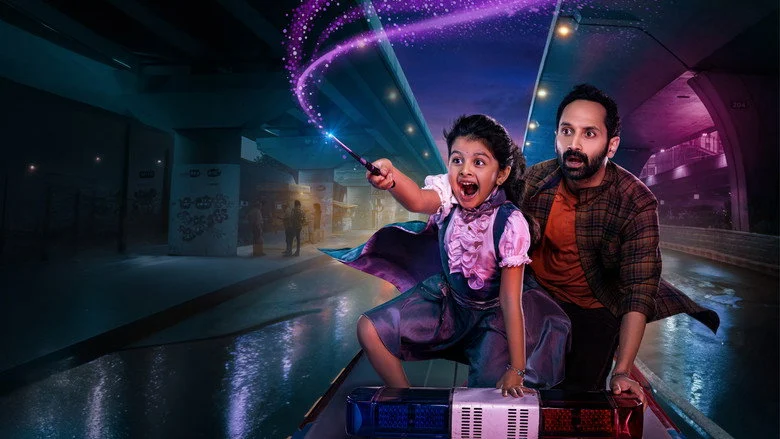

Orijinal (2026): Sreenath Bhasi and a Timeline That Won’t Hold Still
Ramees opens Orijinal on a man meeting himself, and the film never quite recovers from the courtesy of that handshake. What follows is a Malayalam speculative thriller that wants to be a comedy, a puzzle, and a love letter to the butterfly effect, all at once.
Two Sreenath Bhasis, One Unstable Room
The premise is seductive: a protagonist collides with another version of himself from a divergent timeline, and the encounter fractures the present into competing realities. The film treats this not as a superhero gimmick but as an identity wound, memory becomes unreliable, choice becomes recursive, and friendship across timelines becomes the emotional spine.
What Ramees understands is that the most interesting time-travel stories are not about the machine. They are about the moment a person realises the self they’ve been protecting was never singular to begin with.
The Butterfly Effect as a Screenwriting Crutch
Here is where the film’s ambition starts to work against it. The screenplay leans heavily on the “butterfly effect” as an explanatory device, small past alterations producing large present fractures, but the rules governing those alterations stay frustratingly vague.
The middle section becomes a maze of memory and misrecognition, and while that’s thematically coherent, it also means the audience is asked to track two versions of one man without a clear visual or narrative anchor to tell them apart. Confusion is not the same as mystery.
Where a tighter genre sibling like L&O – Law and Order uses procedural structure to ground its tension, Orijinal keeps loosening its own scaffolding until the stakes start to blur. The film wants the disorientation to feel earned; too often it simply feels unedited.
Sreenath Bhasi Carries the Doubling, But the Doubling Doesn’t Always Carry Him
Bhasi is the right actor for this material, his gift has always been a kind of boyish watchfulness, a face that registers confusion before it registers fear. He plays both versions with subtle shifts in posture and vocal register rather than showy theatricality.
There’s a sequence in the second act where the two versions sit across from each other in near-silence, and Bhasi plays the moment with a stillness that recalls the psychological weight he brought to Border Diaries. That scene is the film’s clearest argument for itself.
But the supporting ensemble, Abhiram Radhakrishnan, Rajesh Madhavan, Binu Pappu, Femina George, are given frustratingly little to do beyond orbit the lead’s crisis. They register as textures rather than characters, and the film’s emotional range narrows accordingly.
Ramees Has an Eye, But Not Always a Compass
The direction shows real instinct for intimacy, close framing on faces, a willingness to let silence sit, and the humour is integrated with more grace than most Malayalam speculative films manage. The comic beats don’t undercut the dread; they sit beside it.
What’s missing is tonal control at the structural level. The first half is exposition-heavy, and the second half fragments faster than the emotional throughline can support. The film’s craft is sincere; its architecture is not yet disciplined enough to match its ambitions.
That gap between intention and execution is familiar from this year’s theatrical slate, the same sincerity without structural ruthlessness that marked Sumo Didi. The difference is that Orijinal has a stronger genre engine to fall back on.
What the Box Office Is Actually Betting On
Malayalam cinema has spent the last few years proving that high-concept speculative films can travel beyond the home market, and Orijinal is clearly positioned as part of that wave. The question is whether the film’s identity-puzzle premise can sustain word-of-mouth once the opening weekend curiosity fades.
Bhasi’s draw is real but not yet a franchise-level anchor, and without a named antagonist or a clear villain hook, the marketing has to sell concept over conflict, a harder proposition in a crowded October window. The film’s theatrical life will depend on whether audiences treat the confusion as a feature or a flaw.
For the broader exhibition landscape, this is another test of whether contemporary Malayalam thrillers can keep converting genre curiosity into sustained footfall rather than opening-week spikes.
The Ending Doesn’t Resolve, It Reframes
Without spoiling the mechanics, the film’s final movement asks the protagonist to choose which version of reality to accept, and the answer it offers is more philosophical than plot-driven. That’s a bold choice for a film that has spent two hours teasing causality.
Whether it lands depends entirely on how much the audience has invested in the two Bhasis as separate people rather than as a single performance trick. The film bets on the former; the execution only partially earns it.
Orijinal is a sincere, occasionally transporting swing at a genre Malayalam cinema is still learning to own. It doesn’t fully stick the landing, but the ambition is worth the ticket, and worth arguing about afterward.