L&O – Law and Order (2026): Law and Order (2026): Ranjith Rebuilds the Rookie-Squad Thriller, With a Little Help From His Gods


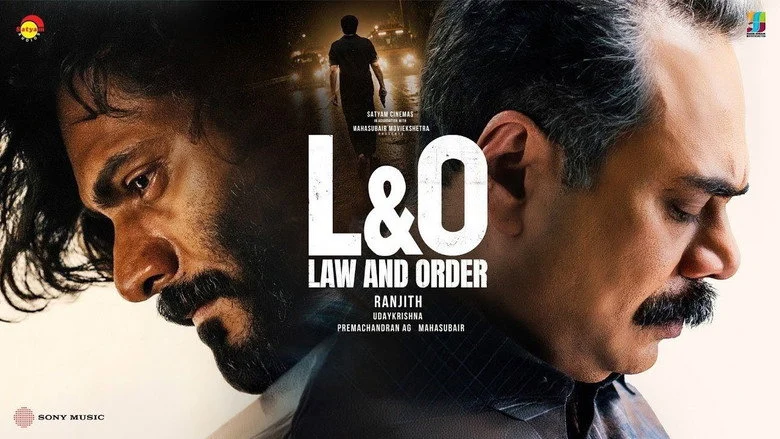
The most telling image in L&O – Law and Order isn’t a shootout. It’s a funeral photograph of a dead rookie propped on a table while five police academy graduates stand around it like pallbearers who haven’t been told whose coffin they’re carrying. Ranjith, working from an Udaykrishna script for the first time in his career, has built a 2h 35m procedural around that exact posture: grief converted into tactical manpower. The film knows what it wants to be, a renegade-squad picture with Kerala dirt under its fingernails, and for long stretches it gets there. What it can’t decide is whether it trusts its own recruits or its returning deities.
For a director whose recent output has drifted between prestige and pulp, this is a sharper swing than the marketing suggests. Those expecting a straightforward mass vehicle should temper their expectations, though our coverage of Vibe review suggests audiences are already wary of star-power propping up thin scaffolding. Here, at least, the scaffolding has been engineered with some care.
The Suicide, the Squad, and the First Real Body
Act one is the film’s most disciplined stretch. DYSP Balagopal (Prakash Varma) loses his son to a drug syndicate run by brothers Pacha and Chotu, and the staging of that loss is deliberately un-cinematic, no slow-motion collapse, no swelling score. Bijibal’s background track stays low and industrial, letting the procedural machinery take over. Balagopal then recruits five academy graduates, and the formation sequence, the one teased in pre-release footage, functions as an audition reel: each recruit gets a gesture, a tic, a physical competence the camera bothers to register. It’s the kind of ensemble seeding that pays off only if the film remembers who these people are later.
It mostly does. When Pacha murders rookie Arun, the film earns its pivot. The murder itself is staged with an ugly matter-of-factness, Shersha Sherif’s Pacha is a sadist who doesn’t monologue, and Ranjith wisely keeps the camera at shoulder height rather than indulging in villain theatrics. The remaining recruits go off-book, and the second act becomes a renegade task force picture, which is where Prasanth Raveendran’s cinematography does its heaviest lifting: Kochi shot as a city of wet concrete and sodium light, back alleys framed tight enough that you feel the squad’s operational claustrophobia.
When the Gods Arrive, the Movie Bows
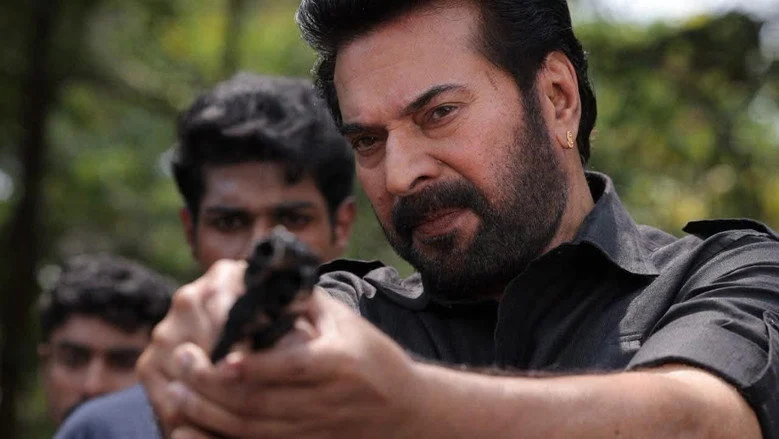
Here’s the problem. The film’s central tension, institutional justice versus vigilante action, is genuinely interesting for about ninety minutes. Then Mammootty shows up as Arakkal Madhavankutty, a retired crime lord pulled back into the fray, and the movie visibly reorganizes itself around his silhouette. The character is a knowing echo of Ranjith’s Black (2004), and that’s fine as homage, but the film’s own recruits, the five kids we watched bury a colleague, become background furniture the moment the veteran enters frame. Mohanlal’s Murugan cameo lands with even less narrative justification; it’s a curtain call, not a character.
This is a craft failure, not a casting one. Ranjith directs the special appearances with the reverence of a man handling relics, and the result is a tonal seam you can see from the balcony. The renegade squad film and the Mammootty film are two different movies sharing a runtime, and the third act’s “war zone” climax, streets turned into a battlefield between law enforcement and the syndicate, plays like the second movie winning the argument.
The comparison to another recent misfire is instructive: our review of Daayra verdict noted how a cop-versus-cop premise collapsed under its own thematic weight. L&O doesn’t collapse; it just capitulates, trading its most original idea for the safest one.
What Actually Works, and What Doesn’t
Works: The recruit-squad mechanics. Varma’s Balagopal is written as a man whose grief has been metabolized into strategy, and the actor plays the procedural scenes with a flat, exhausted competence that suits the material. The urban action is genuinely gritty, Raveendran and Ranjith favor handheld proximity over choreographed spectacle, and the syndicate confrontations feel physically dangerous in a way that big-budget Indian action rarely does anymore.
Doesn’t: The runtime. At 2h 35m, the film’s middle section sags under repeated confrontations that escalate in body count but not in stakes. Udaykrishna’s linear structure is clean, but it’s also incurious, there’s no moral complication to the vigilante premise beyond the standard “we operate outside the law” beat, and the film never seriously interrogates what Balagopal is turning these kids into. The delayed release schedule (pushed from July to September) and the muted pre-release marketing suggested post-production friction, and the finished film’s uneven third act lends that theory some weight. For a broader sense of what’s landing theatrically this season, our Malayalam Thriller reviews track the pattern.
Verdict
L&O – Law and Order is a solid, occasionally sharp police procedural that doesn’t trust its own best instincts. The Ranjith-Udaykrishna pairing produces a genuinely well-staged first half and a compromised second, and the Mammootty-Mohanlal appearances, however crowd-pleasing, cost the film its spine. Mass audiences and Mammootty loyalists will leave satisfied. Anyone hoping for the renegade-squad movie the first hour promises will leave wondering what happened to those five kids.
Rating: 3/5
Watch if: You want gritty Kochi-set action and can tolerate a third act that hands the wheel to its guest stars. Skip if: You were sold on the recruit-squad premise and expect it to be the actual movie.