
Melcow Pondicherry (2026): Arjun Ashokan’s Reunion Thriller Wobbles Between Nostalgia and Survival
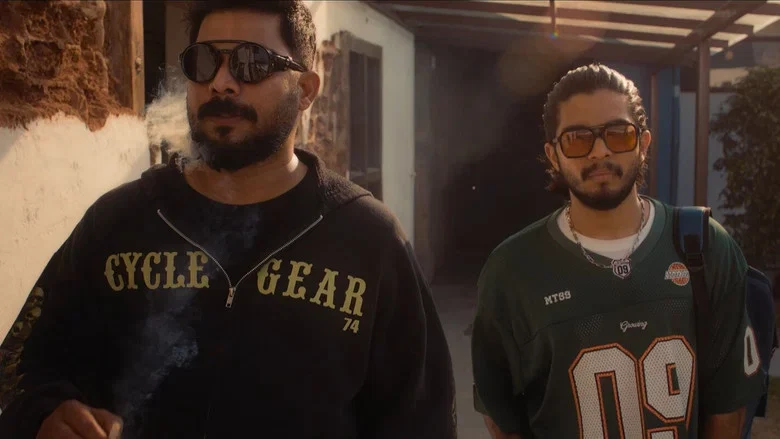
Nikhil Mohan’s debut opens on a bachelor party in Pondicherry, then remembers it has a body count to service. Arjun Ashokan anchors a reunion of expelled college friends whose shared past comes looking for them.
A Bachelor Party That Forgets Its Own Guest List
The premise arrives with a clean charge: five men who were thrown out of college return to the scene of the crime for a celebration. That’s a solid dramatic engine, guilt dressed as nostalgia.
What the film does with it is another matter. The comedy register dominates the early stretch, and the ensemble is asked to be loud where they should be uneasy.
Sanoop Thykoodam’s script treats the expulsion as a punchline before it treats it as a wound. The tonal pivot, when it lands, feels less like escalation than a different film elbowing its way onscreen.
When The Secret Arrives, The Suspense Doesn’t
Buried secrets are the most forgiving suspense device in the genre and the most easily wasted. The film withholds information, but it withholds it without generating pressure.
There is no antagonist with a face and no clock with a visible hand. The friends are endangered by circumstance rather than by a person who wants something from them.
Compare the coiled, intimate unease of Orijinal, which understood that a thriller’s menace lives in the gap between what a character says and what they’re actually doing. Here that gap stays wide open and unexploited.
Rajendran’s presence is the film’s most intriguing card, and the screenplay plays it face-down for too long. His screen energy is genuinely disruptive, a comic threat that could have been weaponized into real dread.
Ashokan Holds The Frame; The Script Doesn’t Hold Him
Arjun Ashokan has the kind of watchful stillness that reads well in close quarters. There’s a moment mid-film where he simply stops talking, jaw set, eyes doing arithmetic on the room, and the temperature drops.
The performance recalls the frayed composure Althaf Salim brought to Pluto, another film where a group dynamic was asked to carry more weight than the plotting could bear.
The supporting ensemble, meanwhile, is given gestures instead of arcs. One friend is the loudmouth, one is the nervous one, and the film is content to let those labels do the work of characterization.
Sreelakshmi Vijayan is introduced with presence and then stranded at the margins of a survival story that never quite decides what to do with her.
A Director Who Trusts Noise Over Silence
Mohan’s camera likes the open Pondicherry streets and the peeling institutional corridors, and there’s a real visual idea buried in the contrast between holiday light and institutional gloom.
But the film keeps cutting away from the tension it builds. A held shot of a closed door would do more work than the frantic coverage that replaces it.
Electronic Kili’s score pushes where it should pull back, underlining beats that were already legible. The result is a thriller that tells you it’s tense rather than letting you feel it.
The editing rhythm in the back half is the real culprit. Scenes arrive, deliver their information, and exit before the audience has a chance to sit in the discomfort.
What Arun Gopy And Justin Mathew Are Betting On
Arun Gopy Excitements and Justin & Mathew Entertainments are staking a debut feature on a star-led ensemble comedy-thriller, a format that has become the most reliable commercial lane in Malayalam exhibition.
The bet is on Ashokan’s draw and the bachelor-party hook, and both are sound. But the survival-thriller pivot asks a youth-comedy audience to switch allegiances mid-film, and that’s a harder sell than the marketing suggests.
The wider problem is a marketplace saturated with films that promise a genre turn and deliver a genre detour. Audiences have grown fluent in that trick, and contemporary Malayalam thrillers are increasingly judged on whether the turn earns its keep.
As a comparison point, the comic discipline on display in Parivarik ManuRanjan shows how much sharper a reunion comedy can be when it commits to its own register instead of hedging toward another one.
The Verdict On A Film Caught Between Two Moods
Melcow Pondicherry has a strong premise, a watchable lead, and a location that does real atmospheric work. What it lacks is the patience to let any of those elements breathe.
The reunion is the film’s best idea and its least developed one. Guilt between old friends is fertile ground, and the movie keeps stepping over it on the way to the next chase.
There’s a version of this story where the secret is a person, the college is a trap, and the bachelor party is the last night of innocence. That version is visible in flashes, and it’s the one worth mourning.
What remains is a competent, uneven entertainer that knows its audience and underestimates them. The friends survive, presumably. The film doesn’t quite escape.