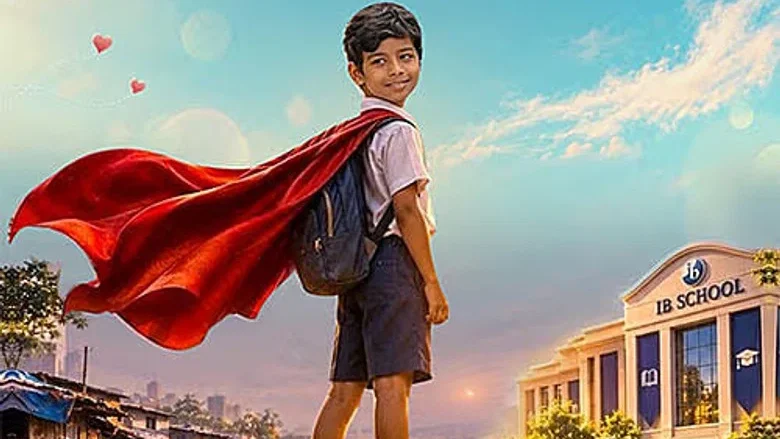
Nanhey Dil (2026): Suniel Shetty Anchors a Gentle Schoolyard Fable That Refuses to Fight
Principal Anthony notices a washerman’s son. That single act of institutional grace ignites Swarupraj Medara’s debut, a school drama more interested in lunchboxes than confrontation.
A Mentor Who Opens Doors Instead of Villains Who Bar Them
The film’s structural gambit is almost defiantly unfashionable. Anthony, played by Suniel Shetty with a deliberate stillness rather than his usual action-man restlessness, gestures Raghu toward an elite English-medium campus and then largely recedes.
What follows is not class war but class weather. Raghu, embodied by Sarvesh Adawade in a performance of visible shrinking, must navigate corridors where fluency and wealth operate as social currency.
Medara constructs his conflict from silence and spatial discomfort rather than shouting. The boy’s inferiority is staged through where he stands, whom he stands beside, and the distance he maintains from the school’s confident center.
When the Antagonist Is a Language and a Lunch Table
The screenplay’s most interesting admission is its refusal to furnish a villain. Privilege itself is the opposing force, an abstraction that proves harder to dramatize than any sneering bully would have been.
Six affluent classmates gradually thaw, and the mechanism of their conversion is homemade food. That’s the entire engine of the second act: kindness routed through a tiffin box.
It’s a warm idea that the film doesn’t entirely trust. The thaw arrives in broad, predictable increments, and the classmates never acquire enough individual texture to register as anything beyond a collective softening.
For a narrative built on the friction between worlds, the friction keeps getting smoothed away. The screenplay reportedly runs a lean hundred minutes, and that tidiness leaves the class tension feeling resolved before it’s been honestly examined.
Shetty’s Restraint and a Child Ensemble Left to Carry the Weight
Shetty’s Anthony is the film’s calmest presence, and his restraint is a genuine departure from the bluster of something like Welcome to the Jungle. He sits, he listens, he says less than the scene expects.
The problem is that Anthony exits the emotional arena too early. The mentor becomes a fixed fixture, and the film’s dramatic charge falls almost entirely on Adawade’s small shoulders.
Adawade does the hardest thing asked of him: he plays fear without playing it for sympathy. His posture tightens in the English class, his eyes track the confident kids before he speaks, and the transition to ease is gradual enough to feel earned.
Among the supporting players, the child ensemble functions as a unit rather than a set of portraits. Sarvar Ahuja and Vrushali Hatalkar appear within that group, but the film gives none of them a defining gesture, so the friendship never individuates.
A Debut That Plays It Safe in the Frame and the Score
Medara’s direction favors the contained geography of a campus: classrooms, courtyards, a tiffin shared on a bench. The visual contrast between Raghu’s modest home and the polished school is clearly intended, though the photography rarely presses it into discomfort.
Shailesh Suvarna’s music carries the warmth the images don’t always earn. The score leans into sentiment early and often, and by the acceptance arc it’s doing much of the emotional labor the screenplay has skipped.
Where the film could have borrowed the tighter spatial discipline of a survival thriller like Pulse, it instead settles for an even, gentle rhythm. Nothing here is badly made; little of it is risked.
The editing mirrors that caution. The first half builds exclusion patiently, but the second half accelerates the thaw, and the shift from alienation to belonging feels less like growth than scheduling.
The Uncomfortable Question the Ending Leaves Unanswered
Acceptance, in this film’s grammar, means Raghu is welcomed into the room. It never quite asks whether the room itself needs to change, or what happens to the next washerman’s son who arrives without a tiffin.
That’s the gap between a heartwarming fable and a social drama. The film chooses the fable, and it chooses it sincerely, but the choice leaves the class critique as decoration rather than argument.
The ending’s warmth is real. The discomfort is that the warmth arrives cheaply, bought with food and friendliness rather than any reckoning with the institution that made Raghu’s fear inevitable.
There’s a lineage here worth noting. The unresolved social tension in Ghamela at least acknowledged its own dead ends; Medara’s film prefers to close the loop and move on.
The Commercial Arithmetic of a Small, U-Rated Heartwarmer
The producing team behind this project carries no established franchise muscle, which makes the release strategy legible: a modest, certificate-friendly family film aimed at parents and school-age children during a crowded theatrical window.
The economics are unforgiving. Without verified collections or a reported budget, the trade math stays opaque, but a child-centered Hindi drama with a recognizable adult star and no spectacle hook is fighting for screens against far louder competition.
Shetty’s presence is the film’s only real marquee leverage, and he’s deployed as a supporting anchor rather than a draw. That’s a defensible artistic choice and a questionable commercial one, since his fanbase expects the man to move, not to sit and nod.
Across contemporary hindi dramas, the middle-budget family film is increasingly a streaming proposition. Nanhey Dil is asking audiences to leave the house for gentleness, which is a hard ticket to sell in 2026.
A Fable That Chooses Kindness Over Confrontation
Nanhey Dil is a decent film with a soft center it mistakes for a spine. It gives Adawade a real arc and Shetty a dignified, understated turn, then declines to test either against anything sharper than a cold shoulder.
What lingers isn’t the friendship or the food. It’s the image of a boy learning to occupy a room built without him, and the film’s quiet decision not to ask who should have rebuilt it.