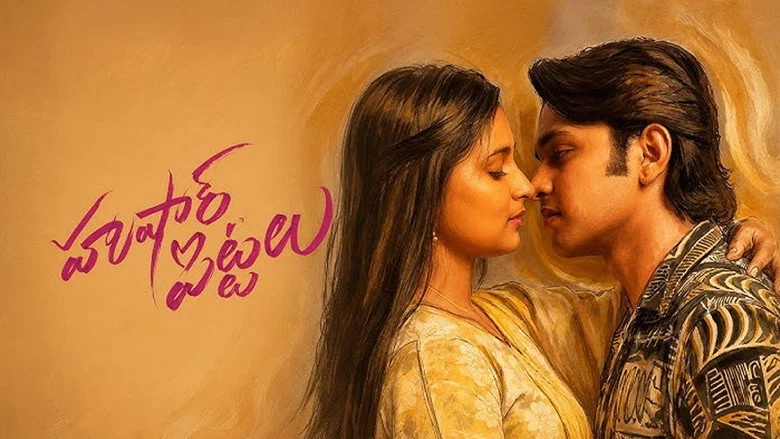
Hushar Pittalu (2026): A Village Romance That Trusts Its Restraint


The first real beat of Bikshu’s Hushar Pittalu is a stolen glance across a village classroom. Ravi, the disciplined class topper, and Chitti, the curious girl beside him, build a secret courtship out of borrowed notebooks and whispered plans. The frame stays wide, letting the dusty afternoon light do the work of suggesting intimacy where none is spoken aloud.
This is a film that understands the quiet thrill of adolescent secrecy, even when it cannot sustain that precision across its 130-minute runtime.
Ansh Thorat’s Ravi is a Study in Controlled Collapse
Ansh Thorat carries the burden of a character who begins as a model student and slowly unravels under the weight of his own choices. His early scenes suggest a boy who has learned to perform discipline for his elders, and Thorat plays that performance with a tight, almost clenched physicality.
As the romance deepens, that restraint cracks. The shift from studious composure to impulsive defiance is the film’s most credible arc, even when the screenplay around him loses focus.
Vasavi Ganeshan’s Chitti is less defined on paper, but she brings a wilful edge to scenes where the script merely asks her to react. Her best moment comes during the family confrontation, where her silence reads louder than the shouting around her.
The Genre Core: Romance Built on Resistance, Not Resolution
Hushar Pittalu operates as a romance-drama that understands conflict better than chemistry. The secret relationship between Ravi and Chitti is framed through the obstacles that surround it, family opposition, peer pressure, and the social judgment of a close-knit village. The screenplay is linear, moving from discovery to defiance to consequence without detours into subplot clutter.
The family confrontation after the affair is discovered is the film’s dramatic peak, a scene where the writing finally commits to the messiness of parental failure and youthful stubbornness. It is here that the director’s intent becomes clear: this is not a love story about winning against the world, but about the collateral damage of immaturity on both sides.
Yet the genre execution stumbles in its middle stretch. The romance lacks the specific, lived-in details that would make the central pair’s bond feel inevitable. We are told they are drawn to each other, but the scenes between them rarely earn that pull through dialogue or gesture. The village setting grounds the tone, but the emotional geography remains frustratingly generic.
The Supporting Cast Anchors the Social Pressure Cooker
Govardhan Reddy and Sunitha Manohar appear as the parental figures whose disapproval drives the plot forward, and both actors bring a weary authority to their roles. Their scenes of quiet disappointment land with more force than any of the louder arguments, suggesting a film that knows its dramatic strengths even when it fails to lean into them.
Ramesh Nakirekanti and Anji Valguman fill out the margins of this social ecosystem, representing the village’s collective gaze. Their casting signals a deliberate intent to make the community itself a character, an invisible antagonist that pressures the couple from every side. This choice keeps the conflict grounded in social realism rather than cartoonish villainy.
The Missing Conversation: A Film Waiting for Its Critics
There is no verified critical consensus on Hushar Pittalu, no publication score to weigh against its ambitions. The absence of a clear antagonist beyond “familial opposition” and “social pressure” is both a strength and a liability, it avoids melodramatic clichés but also leaves the drama without a sharp edge to push against.
What remains is a sincere, modestly crafted coming-of-age story that trusts its audience to find meaning in consequences rather than catharsis. The cinematography by Rudra Sai captures the village’s dusty textures competently, though nothing in the visual language rises above functional storytelling. Charan Arjun’s score, while unverified in reception, appears to serve the film’s restrained tone rather than overwhelm it.
For viewers who value Telugu drama that treats teenage romance as a moral question rather than a fantasy, this film offers a quiet alternative to louder, glossier fare. It is not a film that demands attention; it is one that rewards patience.
If you’re drawn to the moral weight of village-set romances, you might also enjoy browsing more Telugu Drama reviews on our site.
Hushar Pittalu is a film for those who prefer their romance served with consequences rather than confetti. It is a modest, sincere effort that never quite finds the emotional voltage to match its thematic ambitions. Watch it for Ansh Thorat’s careful performance and the film’s refusal to let its young lovers off the hook. I found myself wishing the screenplay trusted its quieter instincts as much as its lead actor does. The best format is a regular theatrical screening, where the village atmosphere can envelop you without distraction.
Hushar Pittalu earns a measured 2.5 out of 5, a film with honest intentions that deserves credit for restraint, even when that restraint costs it dramatic momentum.
For a deeper look at how similar themes of identity and consequence play out, see our take on Equal review.
If you prefer your rural dramas with sharper narrative grip, Aali verdict offers a contrasting study in performance-led storytelling.