Sarvagunn Sampann (2026): Vaani Kapoor’s Identity Comedy Is a Curious, Uneven Period Piece


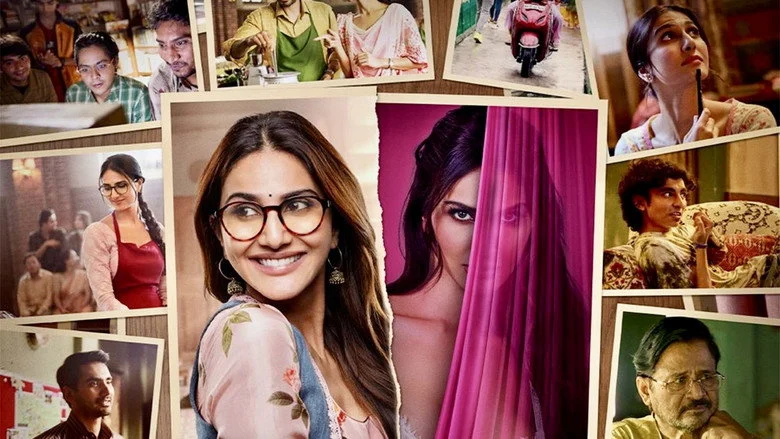
The image is striking: a woman in conventional 1990s styling, suddenly reframed through the bold, unapologetic look of an adult film star lookalike. That transformation sequence, teased in promotional material, is the film’s sharpest visual metaphor for the collision between private self and public perception.
Director Sonali Rattan Deshmukh builds her social comedy around this single, distinctive hook, but the execution feels like a promising sketch waiting for a fuller canvas.
Vaani Kapoor’s Transformation Is the Film’s Only Real Engine
Kapoor carries the burden of a character defined entirely by how others see her. The role demands a visible shift from conventional restraint to a bolder persona, and she handles the physical transformation with commitment.
Yet the script gives her limited room to explore the interior life beneath the lookalike label. She reacts to social judgment more than she initiates her own story, which keeps her performance competent but constrained.
The Direction Finds Texture, But the Screenplay Loses Its Grip
Deshmukh’s decision to set the story in the 1990s is the film’s strongest craft choice. The period texture gives the identity conflict a specific social weight that a present-day setting would have flattened into generic commentary.
The weakness is structural. The screenplay moves linearly through the character’s encounters with family and society, but it struggles to escalate the central conflict beyond repeated variations of the same public judgment scene.
Social Comedy Needs a Sharper Bite
As a social comedy, the film leans on discomfort rather than slapstick, which is the right instinct. The premise, a woman mistaken for an adult film star, carries inherent comic tension, and the 1990s framing allows that tension to breathe without feeling exploitative.
But the comedy never quite lands as satire. The film gestures at hypocrisy and double standards without committing to a pointed critique, settling instead for gentle observation.
The dramatic undertone, meant to balance the humor, also stays underdeveloped. There is a genuine emotional core here about self-acceptance, but the screenplay treats it as a backdrop rather than the main event.
Ishwak Singh, Raghubir Yadav, and the Supporting Cast’s Quiet Work
Ishwak Singh, as the male lead, brings a grounded presence that complements Kapoor’s more performative register. His casting signals a romantic-comedy framework, but the chemistry between the two leads is only sketched in broad strokes rather than developed through specific beats.
Raghubir Yadav and Brijendra Kala are the kind of reliable character actors who instantly signal comic or paternal functions. Their presence suggests the film intends a warm, family-centric tone, even if the available material doesn’t detail their individual moments.
The supporting ensemble, including Namik Paul and Geeta Tyagi, fills out the social world around the lead, but none of them get enough screen time to create a memorable impression.
The Delayed Release and the Audience Question
The film’s journey to Zee5 was marked by a long delay between completion and premiere, which visibly dampened whatever momentum the project might have gathered. The OTT release on August 14, 2026, positions it as a streaming-first curiosity rather than a theatrical event.
Audience response remains thin from available sources, but the identity-and-self-acceptance angle is clearly the hook that drew initial attention. The pairing of Kapoor and Singh was noted in early coverage, suggesting some pre-release goodwill.
There is no verified backlash or political controversy around the adult film star premise, though the subject matter itself invites social discussion. The film seems to have avoided the kind of moral panic that similar premises might have triggered in a theatrical context.
If you are looking for more Hindi social comedies that explore identity with a period setting, Hindi Drama reviews might point you toward similar territory.
An Uneven Watch With a Curious Hook
The premise is genuinely unusual, and Kapoor’s transformation-driven setup is the kind of role that could have been a career highlight with a sharper script. The 1990s setting provides atmosphere, but the screenplay never finds a way to escalate its central idea into a fully satisfying narrative.
I kept waiting for the film to take a risk with its subject matter, to push past the safe middle ground it occupies between comedy and drama. That risk never quite arrives.
For viewers curious about Vaani Kapoor’s range or the specific texture of a 1990s-set identity comedy, this is a reasonable OTT watch. For those expecting a sharp satire or a fully realized character study, it will likely feel like a missed opportunity.
Watch it for the premise and the period craft, but adjust expectations for the screenplay’s inability to follow through on its own ambitions.
Sarvagunn Sampann is a curious, uneven experiment that earns a middling 2.5 out of 5 for its bold setup and undercooked execution.
For a more complete take on identity-driven storytelling, Magudam review offers a different angle on dual roles and public perception.
If you prefer lighter territory with familiar chemistry, Hi verdict packages comfort in a more conventional rom-com frame.