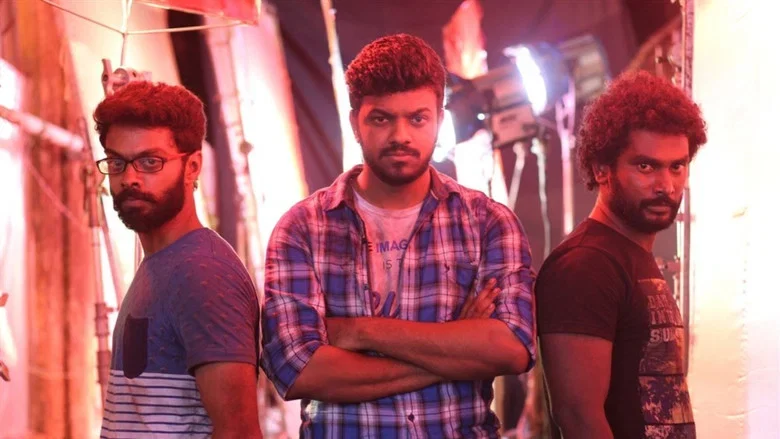
Angelina (2026): Vinoth Kishan’s Tamil Drama Pivots From Romance To A 24-Hour Suspect Hunt
The six-month courtship wager lands on the table like a contract, and the film expects us to smile at its audacity. Then the same girl turns up broken, and the clock starts shouting.
When A Courtship Deadline Becomes A Countdown To Find A Killer
Angelina opens in the register of a college-set romance, all teasing ultimatums and the mild cruelty of a woman testing a man’s patience. She hands a local suitor six months to earn her affection, an arrangement that plays less like passion than a wager with a visible finish line.
That deadline is the film’s most efficient narrative device, because it teaches us early to measure love in units of time. When the story later compresses into a twenty-four-hour police search, the grammar already feels native to the film’s world.
The pivot arrives with Angelina found critically injured, and the investigation turns its gaze inward on the people who claimed to love her. It is a canny structural move: the suspect pool is not a criminal underworld but a trusted circle, and every warm gesture in the first act gets retroactively audited.
The Ensemble Mystery Betrays Its Own Promise Of Suspicion
A mystery built on intimate betrayal needs the audience to genuinely doubt the people on screen. That requires the supporting figures around Angelina to hold weight of their own, to have private lives the camera has already made us curious about.
What the film offers instead is a ring of acquaintances who function mostly as procedural furniture, present to be questioned and then quietly cleared. The suspicion never curdles into real unease because we were never given enough of these people to mourn or mistrust.
Vinoth Kishan carries a low, steady register in the interrogative stretches, keeping his voice flat and his hands still while the room around him gets louder. It’s a disciplined choice, though the screenplay gives him few moments where stillness reveals something a line of dialogue hasn’t already told us.
The tonal handoff from courtship to crime is where the film’s ambition outruns its grip. The romantic passages are shot with a soft, unhurried warmth, and the investigation switches to tighter framing and colder light, but the two halves feel stitched rather than fused.
Comparatively, the tonal whiplash here is milder than the structural stumbles of Haiku, which also tried to braid romance with a darker thesis and lost its footing midway. Angelina at least knows which clock it is racing against.
Monica Chinnakotla Holds The Frame Before The Film Takes It Away
Monica Chinnakotla’s Angelina is most alive in the early scenes, where she uses a slight tilt of the head and a delayed smile to keep her suitor off balance.
She plays the character as someone who enjoys the power of being wanted, and that small vanity makes her later absence from the frame feel like a loss rather than a plot function.
Once she is hospitalized, the performance narrows to a body on a bed, and the film’s emotional center of gravity shifts to the men investigating her. It’s a familiar structural trade-off in Tamil drama, and it costs the film the very character whose contradictions were holding our attention.
The film’s romantic instincts sit closer to the tender, unhurried register of Nooru Kodi Vaanavil, though that film’s emotional patience is replaced here by a ticking procedural urgency. Where one lingers, the other cuts away.
Direction That Trusts Silence More Than It Trusts Its Script
The filmmaking shows a real instinct for negative space, particularly in the hospital corridor scenes where the camera holds on empty doorways before anyone walks through them. Those held frames do more suspense work than any raised voice in the interrogation room.
The score, by contrast, is less disciplined, arriving early to tell us how to feel about a reveal the staging has already handled. There’s a recurring habit of underlining a suspicion with a low string swell just as an actor’s face was doing the job fine on its own.
At just over an hour and a half, the film moves briskly, but the compression works against the mystery. A twenty-four-hour deadline should feel suffocating, and instead the investigation resolves with a tidiness that suggests the filmmakers were more interested in the premise than in the puzzle.
This restraint in pacing, favoring conversation over kinetic set pieces, is part of a broader shift toward character-rooted tension across contemporary Tamil dramas, even when the execution doesn’t fully earn the patience it asks for.
A Modest Production Bet In A Crowded Theatrical Market
The film arrives without the muscle of a major banner behind it, and that commercial modesty shapes everything about its release strategy. There is no star-vehicle scaffolding here, no franchise hook, and no marketing spectacle to carry it past a crowded weekend.
For a mid-budget Tamil drama with an unproven theatrical footprint, the opening weekend is the entire game. Without strong word of mouth from the first shows, a film like this loses screens fast, and the absence of a bankable marquee name makes that cliff steeper.
Vinoth Kishan’s theatrical leverage remains that of a respected character actor rather than a draw, which places the film’s fortunes squarely on the strength of its premise. That premise is genuinely interesting, but interesting premises don’t fill seats without a reason to leave the house.
Compared to the broader franchise ambitions of something like Lakadbaggha 2, this film is playing an entirely different and much riskier commercial sport.
The Uncomfortable Truth Buried In A Neat Resolution
What lingers after the credits is not the identity of the culprit but the film’s quiet argument that intimacy is a liability. Every relationship Angelina built becomes evidence against someone, and the film never quite reckons with how corrosive that idea is.
Instead, it resolves into the comfort of a closed case, and the emotional cost of that closing is left on the floor. A story about how love turns into suspicion deserves an ending that admits the damage can’t be undone by an arrest.
Angelina is a film with a sharp structural idea and a soft follow-through, worth the ticket for its central pivot and its lead’s early scenes. It just never trusts its own darkness enough to let the suspicion really bite.