Enna Vilai (2026): Sajeev Pazhoor Swaps His Pen for a Megaphone, and the Silence Is Deafening


Verdict first: 3/5. Sajeev Pazhoor, the man who wrote Thondimuthalum Driksakshiyum, arguably the finest screenplay to come out of Malayalam cinema in the last decade, steps behind the camera for the first time with Enna Vilai. The result is a film that knows exactly what it wants to say and says it with the subtlety of a fisherman’s net hurled at your head. It is sincere, beautifully performed, and structurally lopsided in ways that its festival laurels conveniently obscure.
To be clear: this is not a bad film. It is a frustrating one, the kind that reminds you that writing a great screenplay and directing one are two entirely different muscles, and only one of them is flexed here.
The Pendant and the Price Tag: What Actually Happens
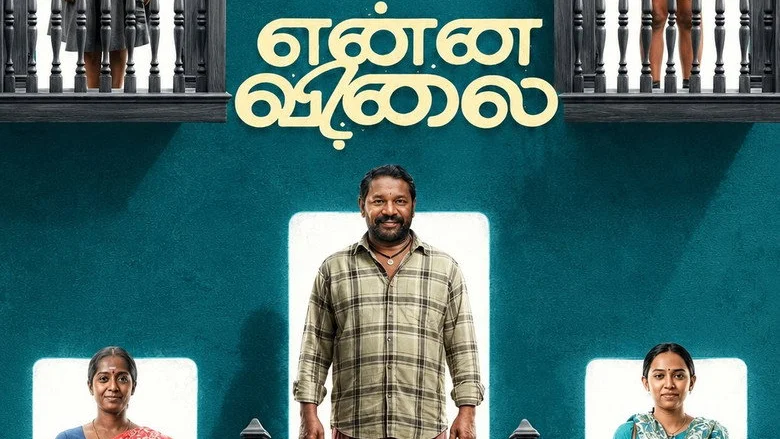
Karunaas plays Thavasi Muthu, a Rameswaram fisherman whose livelihood depends on an unusual economy: coins that devotees toss into the sea as offerings. He retrieves them. It is a livelihood built on the residue of other people’s faith, which is a genuinely brilliant metaphor that Pazhoor the writer understands instinctively. Then Thavasi finds a gold pendant washed ashore, and the film’s machinery kicks into gear, false accusations, community suspicion, escalating threats to his dignity, and eventually a legal battle against a system designed to crush men like him.
The premise is airtight. The execution of the middle act is where Enna Vilai begins to wheeze. Pazhoor’s screenplay moves in a strictly linear fashion, discovery, accusation, escalation, courtroom, and the transitions between these beats are often abrupt rather than earned. The film wants to be a slow-burn social thriller, but it lacks the patience to actually burn slowly.
Karunaas at 25 Years: The Film’s Beating Heart
Karunaas marks a quarter-century in Tamil cinema here, and his casting is the film’s smartest decision. He connected with the story immediately during narration, and you can feel that ownership in every frame. His Thavasi is not a martyr or a saint, he is a man who has learned to move quietly through a world that has no interest in his survival. The performance is natural in a way that rural Tamil cinema often mistakes for laziness; it is not. It is restraint.
Nimisha Sajayan’s Adv. Kanchana is the film’s other anchor. She was offered a choice between two characters and picked this one, a decision that speaks to her instincts, because Kanchana is the film’s conscience without ever being its mouthpiece. Vijayalakshmi’s Pallama has been described as “hard-hitting with emotional space, ” and that description is accurate: she gets the film’s most volatile beats and lands them without chewing scenery.
But here is the problem. For a film with this many characters, Y.G. Mahendran, Poornima Bhagyaraj, Nizhalgal Ravi, Deepa Shankar, and a supporting bench deep enough to fill a wedding hall, very few of them get the space to become people rather than positions. Pazhoor the writer knows how to build an ensemble. Pazhoor the director does not yet know how to give it room to breathe.
The Craft Question: 56 Locations, One Register
Cinematographer Alby Antony shot across 56 locations in Rameswaram, Chennai, Puducherry, and Kochi, and the coastal texture is the film’s most consistently successful element. The sea is not just a backdrop here, it is the antagonist’s accomplice, the source of both Thavasi’s meager income and his undoing. Sam C.S.’s score, anchored by the first single “Kadaladum” (vocals by Antony Daasan), understands this. The music does not underline emotion so much as it hovers beneath it, which is the right call.
Editing by Sreejith Sarang is where the film’s structural problems become most visible. The first half moves with a patient, observational rhythm that suits the material. The second half, the legal battle, the confrontation with power, accelerates into something closer to a procedural, and the tonal shift is jarring rather than deliberate. Pazhoor wants the courtroom to feel like a climax. Instead, it feels like a different film.
For a sharper example of how to sustain tension across a socio-political narrative without losing tonal coherence, see our review of Hanuman Ansh review, which wrestles with similar structural questions.
The Festival Problem: When Acclaim Becomes a Crutch
Enna Vilai arrives with a suitcase full of festival wins: Best Feature Film at Mannheim Arts and Film Festival, Best Screenplay at the Dadasaheb Phalke International Film Festival, selections at Kaia International Film Festival in Istanbul and the Atlanta Indian Film Festival. These are not trivial achievements. They are also not evidence that the film works as a piece of cinema.
Festival juries reward intention. They reward social relevance. They reward performances that feel lived-in rather than performed. What they sometimes fail to reward is the invisible architecture that makes a film hold together for 124 minutes, the transitions, the pacing, the confidence to let a scene end before it has said everything it wants to say. Enna Vilai is a film that has been rewarded for what it is about. It has not been sufficiently interrogated for how it is about it.
The U/A certificate controversy, Pazhoor expressed surprise at receiving it, believing the film warranted a clean U, is a revealing detail. It suggests a filmmaker who sees his work as fundamentally wholesome, a “clean entertainer” with a social conscience. That self-perception is not wrong, exactly. But it does explain why the film’s darker instincts, the ones that made Thondimuthalum Driksakshiyum so unsettling, are kept on a leash here.
What Works, What Doesn’t, and Who Should Care
The film’s greatest strength is its refusal to turn Thavasi into a symbol. He is a man with a family, a routine, a set of skills that the world does not value. When the system comes for him, it does not come because he is special. It comes because he is vulnerable. That is the film’s thesis, and it is a good one.
Its greatest weakness is that it does not trust that thesis to land without assistance. The courtroom sequences spell out what the coastal sequences already showed us. The dialogue, where it should cut, explains. The result is a film that is most powerful when it is quiet and least powerful when it is loud.
For a counterpoint on how a similar thematic terrain, the individual crushed by systems of power, can be handled with more consistent tonal control, our review of Last Man verdict offers a useful comparison.
This is a film for class and family audiences who want their social dramas sincere and their performances grounded. It is not for viewers who need their thrillers to actually thrill, or who expect the director of a festival darling to have solved problems that most first-time directors haven’t. The theatrical release is the right call, the coastal photography deserves a big screen, but the Netflix acquisition suggests the producers know where most of the audience will actually find it.
At an estimated budget of Rs 7 crore, the economics are modest. Whether Enna Vilai becomes a hit depends less on its quality than on whether Tamil audiences are hungry for this particular flavor of sincerity. They might be. The film has a good heart, a great lead performance, and a metaphor that deserves a better vehicle.
What it does not have is a director who yet knows how to get out of his own screenplay’s way. Pazhoor the writer has given us one of the great modern Indian films. Pazhoor the director has given us a promising first draft of a filmmaker. The gap between those two things is the story of Enna Vilai.
Rating: 3/5