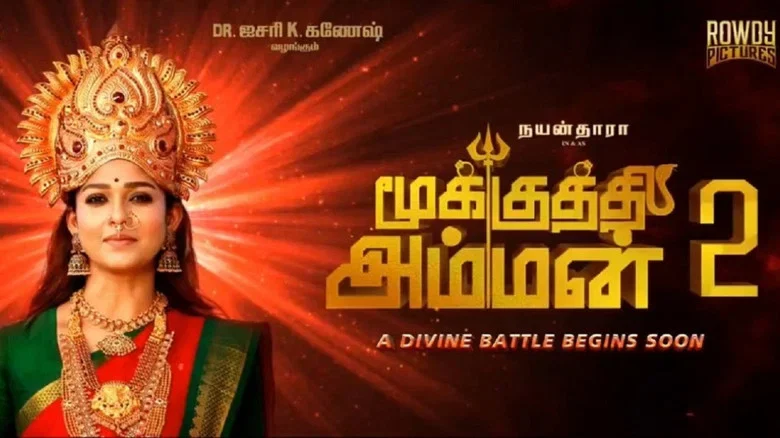
Mookuthi Amman 2 (2026): Nayanthara’s Divine Duality Can’t Quite Tame Sundar C’s Sprawling Mythos
The opening frame lands like a temple bell struck too close to your ear: a queen steps into the path of invading steel so her son might live. Sundar C wants us to feel the weight of that blood before the present day even exhales.
What follows is a Diwali release that swings for mythological spectacle and occasionally clips the ceiling of its own ambition. Nayanthara returns to the divine fold, but this time she’s carrying two bodies and one very crowded timeline.
A Queen’s Sacrifice Is A Strong Hook, But The Cut To Modernity Is Bruising
The period prologue is the film’s most confident stretch. Two forces mass at the edges of the frame, and the staging leans on silhouette and firelight rather than digital noise, letting the threat of chaos sit in the air like smoke.
Then the film drops us into a frightened police officer’s shoes, and the tonal gear-shift is abrupt enough to induce whiplash. The screenplay trusts the audience to hold both registers, and for a while, the dissonance is productive rather than sloppy.
That parallel-timeline architecture is where the film’s real gamble lives. Just as he demonstrated a tighter spatial discipline in Scene, Sundar C here strips away some of the decorative flourishes of his horror-comedy past, though he can’t resist the occasional gratuitous crane shot.
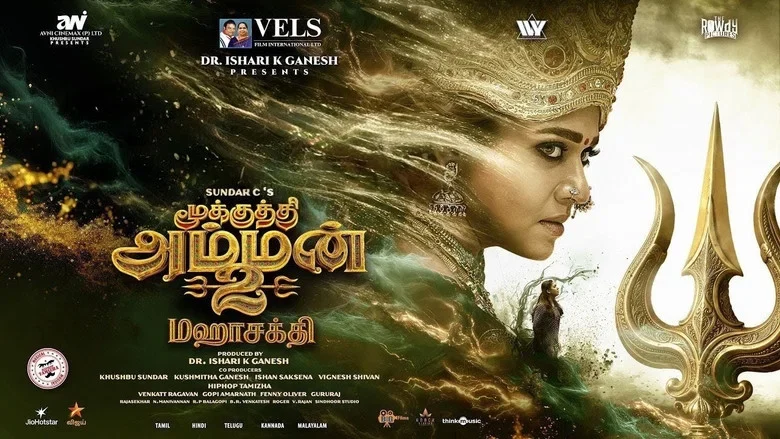
Nayanthara’s Two Bodies Are The Engine, And The Problem
The film’s central mechanism is an identity reveal, and Nayanthara is asked to carry both halves of it. As the trembling officer, she shrinks into doorframes and drops her voice to a near-whisper, her shoulders rounded like a woman bracing for a blow that never quite lands.
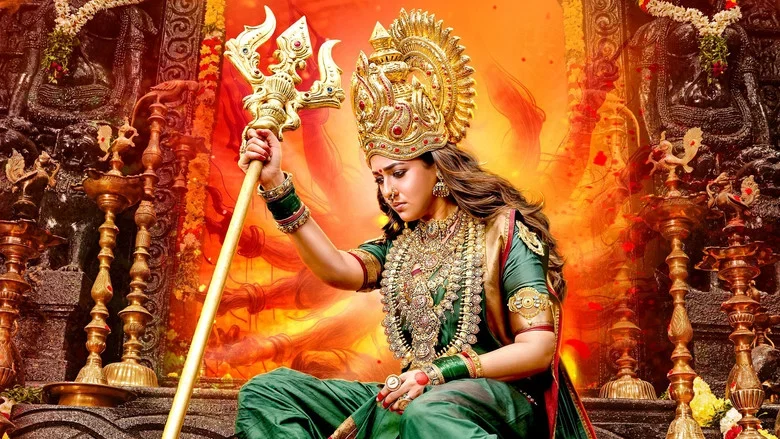
As the goddess, she straightens into something architectural: chin level, gaze fixed on a point just past her adversary’s ear, the kind of stillness that reads as authority rather than absence. It’s a clean contrast, and it gives the film its only reliably grounded emotional anchor.
The restrained physical exhaustion she brings to the officer’s panic recalls the psychological weight of her turn in Toxic, where she similarly played a woman negotiating a myth larger than herself. Here, though, the duality is more schematic, and the script doesn’t always give her room to find the seam between the two women.
Regina Cassandra’s antagonist is the film’s best piece of casting instinct. She plays the sorceress with a lazy, almost bored menace, letting her hands hang loose at her sides while her voice drops into a register that suggests she’s already won the argument.
The Supporting Ensemble Is A Crowd, Not A Chorus
Urvashi and Yogi Babu are deployed as comic pressure-release valves, and both get a handful of moments where their timing rescues a sagging scene. Urvashi, in particular, has a bit of business with a temple offering that lands cleaner than most of the scripted jokes around it.
Beyond that pair, the ensemble blurs into a mass of royal relatives and temple elders who exist to react rather than to act. Duniya Vijay and Abhinaya are given almost nothing to do but stand in the frame and look appropriately solemn, which is a waste of both performers.
The film’s mythology expands to accommodate three additional divine entities, and each arrival thins the dramatic stakes rather than thickening them. The screenplay resists the kinetic sensationalism that overtook Nayyi Navelli, opting instead for a deliberate, almost suffocating dread, but that patience isn’t always rewarded.
Sundar C’s Scale Is Impressive, His Control Is Not
Gopi Amarnath’s camera does its best work in the period sequences, where the lighting is sourced from torches and the frame is kept tight on faces rather than wide on armies. The modern-day material is flatter, lit for clarity rather than mood, and the contrast feels less like a design choice than a budget concession.
Hiphop Tamizha’s score leans hard on devotional swells and percussive stings, and it’s most effective when it drops out entirely during the officer’s quieter moments of dread. The problem is that the film rarely trusts silence for long, filling every pause with another musical cue.
At roughly two and a half hours, the edit has to carry the weight of two timelines and a growing pantheon, and the second half starts to feel its own length. The confrontation the trailer promised arrives, but it’s surrounded by so much mythological housekeeping that the emotional payoff gets diluted.
The Box-Office Math Is Murkier Than The Mythology
Avni Cinemax, Rowdy Pictures, and Vels Film International are betting on a Diwali window and Nayanthara’s devotional-fantasy pedigree to carry this one, and the advance-booking signal is modest rather than explosive. The reported ₹33.74 lakh in Tamil 2D Day 5 advance bookings suggests curiosity rather than frenzy.
The franchise lifecycle here is the real question. The 2020 original was a compact, self-contained devotional comedy, and this sequel’s expansion into a multi-timeline cosmology is a bet that audiences want a universe rather than a parable. That’s a riskier proposition in a market that has grown wary of bloated mythologies.
Nayanthara’s theatrical leverage remains real, but this film asks her to sell a concept as much as a character. Whether that translates into sustained footfalls across the Diwali week is the number the producers will be watching, and the early signals don’t yet justify a victory lap.
What’s clear is that this patient, character-forward approach signals a welcome tonal maturity across contemporary Tamil fantasy, even when the execution doesn’t fully match the ambition.
The Ending Resolves The Battle But Not The Question
The climax delivers the confrontation the trailer promised, and Nayanthara’s goddess finally gets to occupy the frame with the full weight of her authority. But the resolution leaves the officer’s human journey oddly unresolved, as if the film is more interested in the next installment than in the woman we met in the first act.
That’s the film’s central limitation. It builds a mythology large enough to sustain a franchise but forgets to close the emotional loop of the character who made us care in the first place.
Sundar C has made a sequel that’s bigger, stranger, and more ambitious than its predecessor, and Nayanthara gives it a spine. But a film that ends on a cliffhanger is asking for patience it hasn’t quite earned, and the divine spectacle can’t quite cover the hole where a human resolution should be.